Apr 2026 · AI Strategy
Anthropic's Four-Day Sprint: What Actually Shipped in April 2026
NotebookLM Podcast
Anthropic's Four-Day Sprint: What Actually Shipped in April 2026
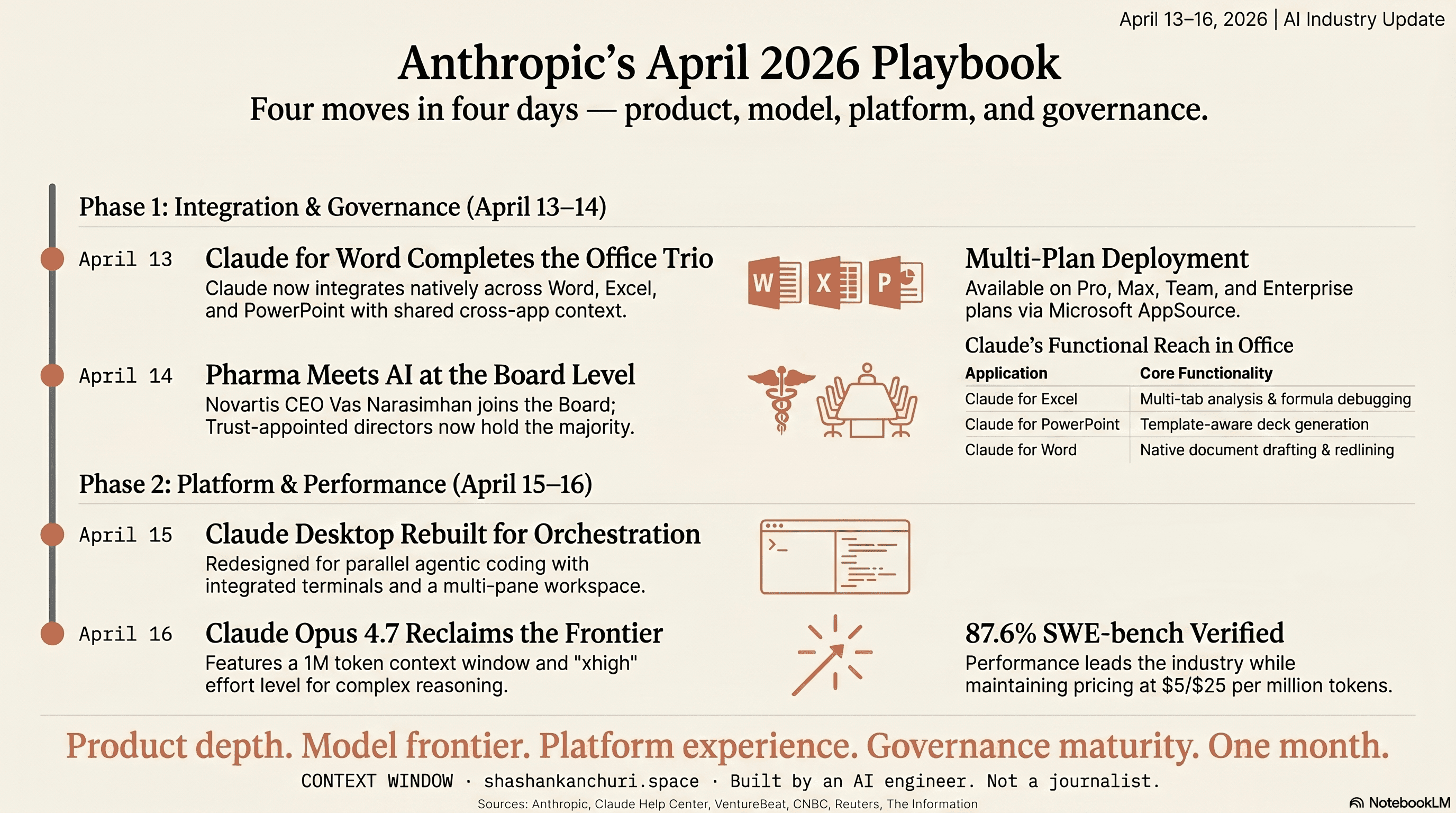
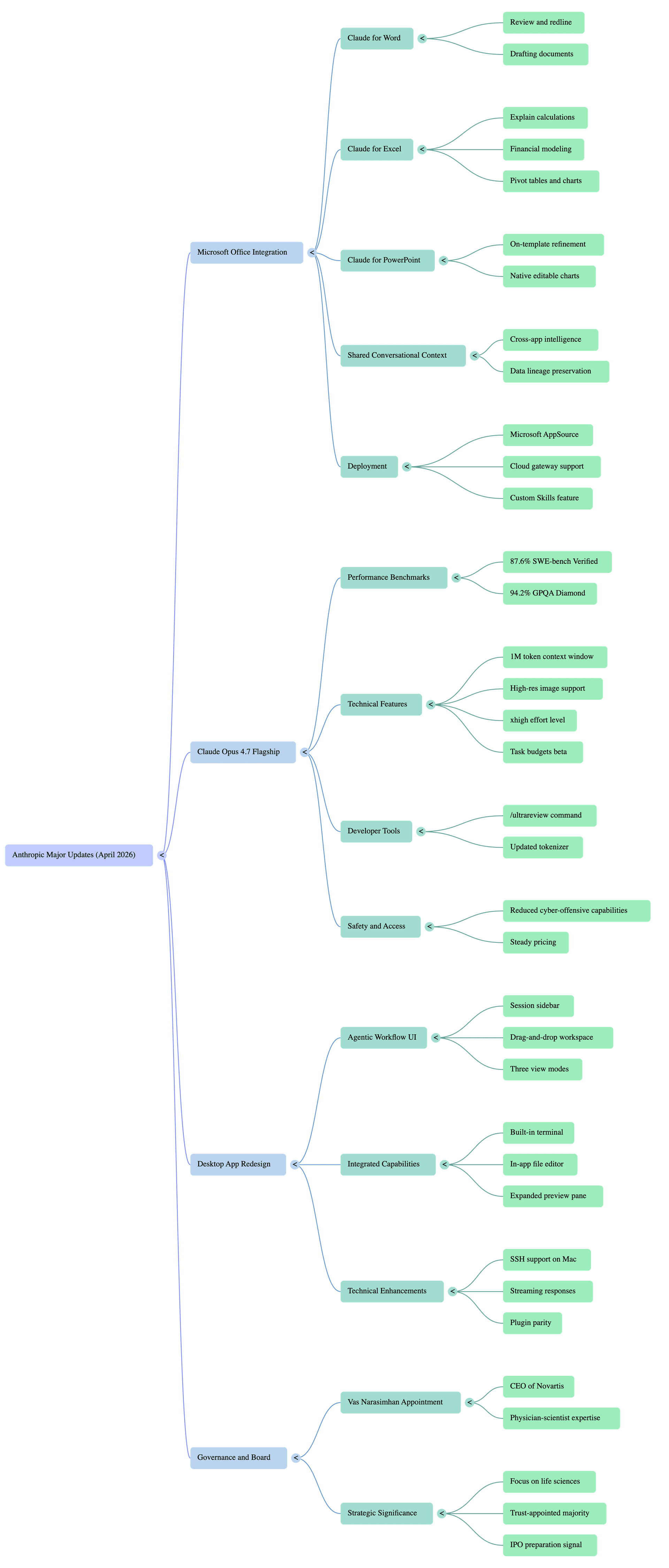
Anthropic had one of those weeks where the release notes read like a strategy doc. Between April 13 and April 16, the company completed its Microsoft Office integration, shipped a new flagship model, redesigned the desktop app from scratch, and added a Novartis CEO to its board. Four announcements, four days, four different layers of the business.
Most coverage treats this as a breathless round-up. This one's for people who actually use the tools and care about the implementation details: what changed, what it costs, and whether it holds up under real workloads.
The Office Trio Is Finally Complete
On April 13, Anthropic launched the Claude for Word add-in, which closed the loop on native Word, Excel, and PowerPoint integration. The March update already gave Excel and PowerPoint shared conversational context. Word now joins the same session.
The practical version: open an Excel workbook, ask Claude to build a trading comps table from the data, switch to PowerPoint where Claude uses that same analysis to generate a valuation slide on your template, then move to Word for the client memo. No re-uploading, no re-prompting, no copy-paste. Claude remembers the whole chain.
The add-ins ship through Microsoft AppSource and run on Windows, Mac, and Web. Enterprise deployment goes through Amazon Bedrock, Google Cloud Vertex AI, or Microsoft Foundry, so if your org already has an LLM gateway, you probably don't need to provision separate Claude accounts. Skills - which lets teams save standardized workflows as one-click actions - now works inside the add-ins too.
So what: If your day involves moving numbers between Excel, slides, and written deliverables, this is the update that affects you most. The shared context is the feature that actually saves time. The rest is table stakes.
Claude Opus 4.7: The New Flagship
On April 16, Anthropic released Claude Opus 4.7. It is the company's most capable generally available model, a direct upgrade to Opus 4.6, though the more aggressive Mythos Preview remains limited to Project Glasswing cybersecurity partners.
The benchmark numbers are real: SWE-bench Verified jumped to 87.6% from 80.8%, CursorBench to 70% from 58%, GPQA Diamond to 94.2%. On directly comparable evaluations, 4.7 narrowly leads GPT-5.4 and Gemini 3.1 Pro, but benchmark leadership now lasts weeks, not quarters.
| Benchmark | Opus 4.7 | Opus 4.6 |
|---|---|---|
| SWE-bench Verified | 87.6% | 80.8% |
| CursorBench | 70% | 58% |
| GPQA Diamond | 94.2% | 91.3% |
The features developers will actually use: a 1M token context window at standard API pricing with no long-context premium; high-resolution image input up to 2,576px with better pointing, counting, and localization; a new xhigh effort level that sits between “high” and “max” for finer control over the reasoning-depth-versus-cost tradeoff; and task budgets in public beta, which let you cap total tokens across a full agentic loop so a runaway agent doesn't generate a runaway bill. Claude Code also gets /ultrareview, designed to simulate a senior reviewer flagging subtle design flaws, not just syntax errors.
One thing to budget for: Opus 4.7 uses a new tokenizer that can consume 1.0-1.35x more tokens on the same input. Pricing stays at $5 in / $25 out per million tokens, unchanged from 4.6, so that tokenizer delta is real money at scale. Box's early testing points the other way: 56% fewer model calls, 50% fewer tool calls, 24% faster responses, 30% fewer AI units consumed versus 4.6 on their workloads. If that holds for you, 4.7 is cheaper to run than its predecessor despite the tokenizer change.
So what: If you're building agents or running Claude in production, xhigh effort, task budgets, and the new tokenizer warrant a day of testing before you roll this into prompts and pipelines you already depend on.
The Desktop App, Rebuilt Around Parallel Agents
Claude Code's desktop app got a ground-up redesign. The framing in Anthropic's own blog is honest: agentic coding doesn't look like one prompt and a wait anymore. It looks like a refactor running in one repo, a bug fix in another, a test pass in a third, with the developer in the orchestrator seat.
The new app is built for that shape of work. A session sidebar shows every active and recent task, filterable by status, project, or environment. The workspace is drag-and-drop: chat, diff, preview, terminal, file editor, plan, tasks, and subagent panes arrange into whatever layout fits how you work. There's an integrated terminal that shares the session's working directory, a proper in-app file editor, a rebuilt diff viewer designed for large changesets, and an expanded preview pane that handles HTML, PDFs, and local app servers. Three view modes (Verbose, Normal, and Summary) let you dial in how much of Claude's tool-calling you actually want to see. SSH support now extends to Mac. Responses stream as they generate.
So what: If you've been managing multiple Claude Code sessions across terminal tabs, upgrade. If you're a solo developer working one task at a time, the old interface was fine and the new one is a learning curve.
Vas Narasimhan on the Board
The quietest announcement of the week is arguably the most strategically loaded. On April 14, Anthropic's Long-Term Benefit Trust appointed Vas Narasimhan - physician-scientist and CEO of Novartis - to the Board of Directors.
Two things are worth noting. Narasimhan is the first pharmaceutical executive on Anthropic's board. He's overseen more than 35 novel medicine approvals at Novartis and spent years earlier in his career on HIV/AIDS, malaria, and tuberculosis programs across India, Africa, and South America. That's experience shipping consequential products through one of the most heavily regulated industries on earth. With his addition, Trust-appointed directors now hold the majority on the board.
Neither fact is accidental. Anthropic is reportedly weighing an IPO as early as Q4 2026. Adding a globally respected pharma CEO signals a strategic push into life sciences applications and a governance posture that reflects a Public Benefit Corporation preparing for public markets.
So what: If you're watching Anthropic as a long-term bet - as an investor, a customer, or someone tracking AI governance - this is the update that tells you where the company wants to be in five years, not five months.
The Shape of the Strategy
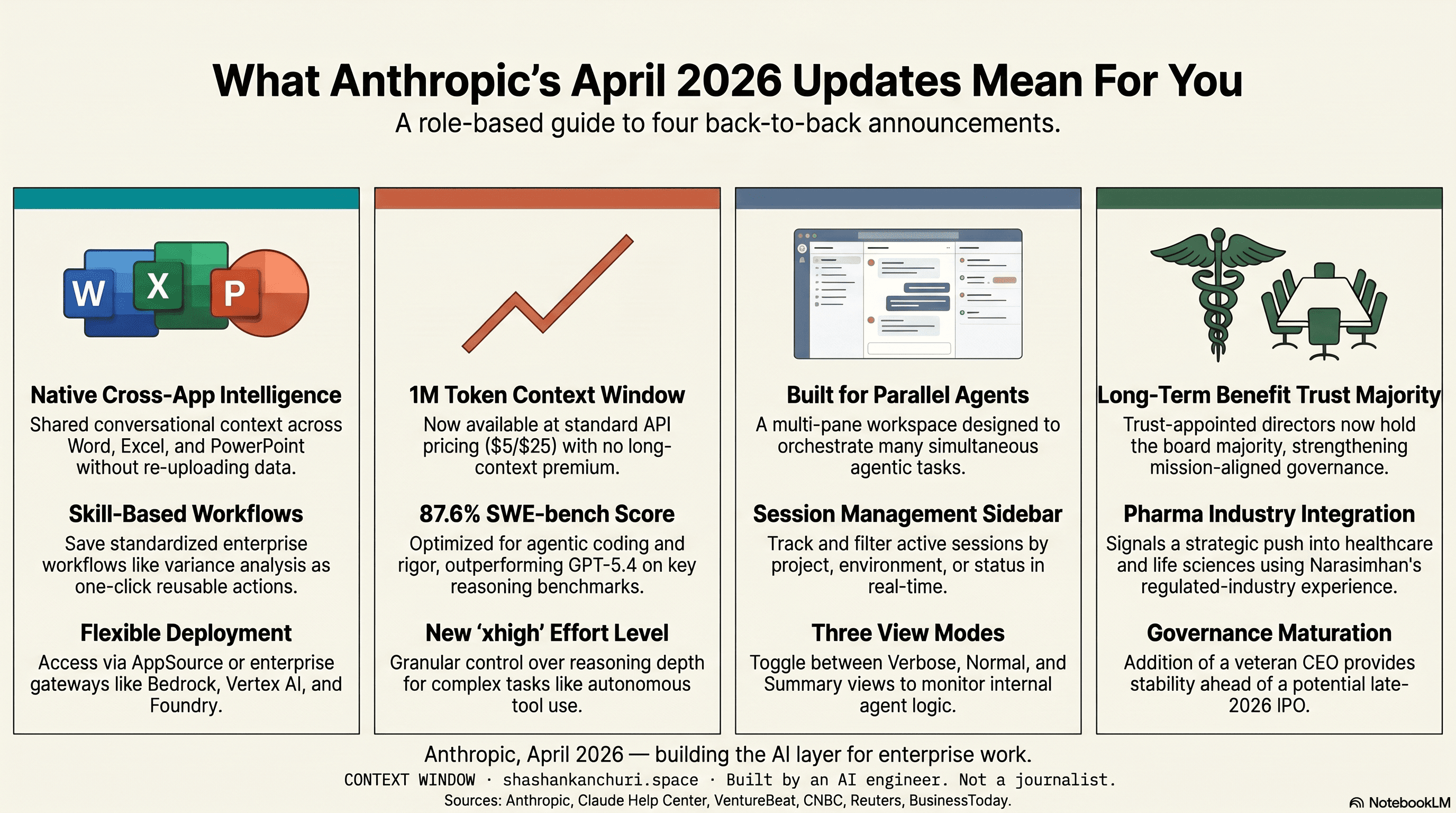
Read individually, each announcement is news. Read together, they are a strategy.
Product depth - Claude now embedded across the apps knowledge workers live in. Model frontier - Opus 4.7 back in the lead. Platform experience - a desktop app designed for how agentic work actually happens. Governance maturity - a board composition that reflects where the company is headed.
Four layers, one direction. Anthropic is no longer positioning itself as a model lab. It is positioning itself as the layer between the frontier model and the work you do every day.
The question for the rest of 2026: which of these four compounds first in your workflow?
Context Window, built by an AI engineer. Not a journalist.