May 2026 · AI Infrastructure
Anthropic and SpaceX: The Deal Nobody Saw Coming
NotebookLM Podcast
Anthropic and SpaceX: The Deal Nobody Saw Coming
The Surreal Part Has to Come First
Earlier this year, Elon Musk called Anthropic “misanthropic and evil.” He has repeatedly attacked the company and its CEO in public. Yesterday, Anthropic announced it's renting every GPU in Musk's Memphis data center.
I want to be precise about what happened here, because the wrong framing is already spreading. This is not a merger or an acquisition. No equity changed hands, no corporate structures combined, no boards reshuffled. Anthropic and SpaceX are still separate companies with separate investors, separate products, and separate CEOs who appear to have said genuinely unkind things about each other in public.
What this is: a compute capacity agreement. Anthropic pays SpaceX for access to GPUs. SpaceX provides compute. They part ways when the arrangement expires or someone decides not to renew. It's a vendor relationship. Extraordinary in scale, genuinely strange given the personal history, but a vendor relationship.
The “merger” framing needs to die before it takes root. Kill it when you see it.
What Was Actually Announced
On May 6, 2026, at Anthropic's Code with Claude developer conference in San Francisco, Chief Product Officer Ami Vora announced three changes effective immediately.
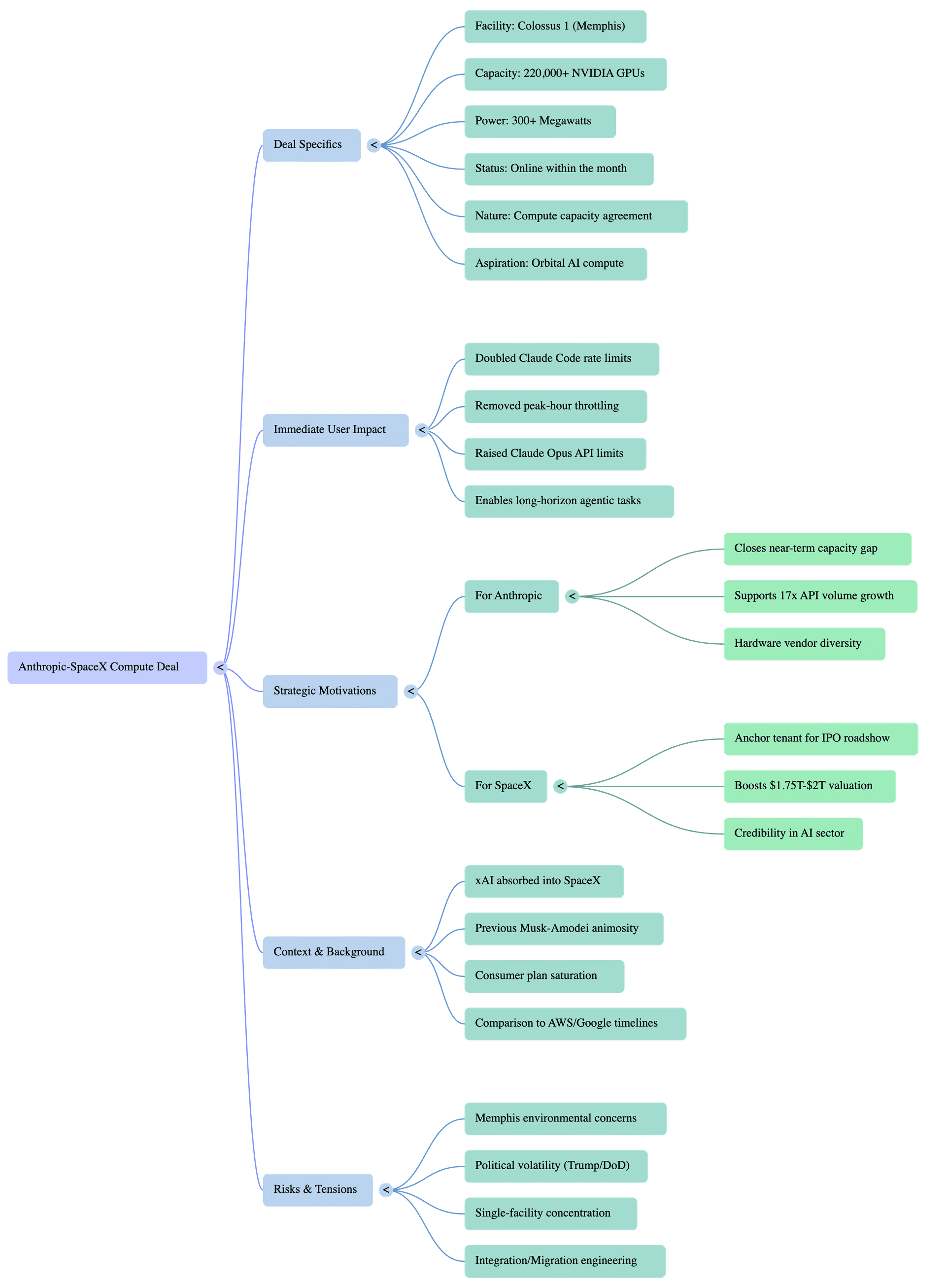
First: Claude Code's five-hour rate limits are doubled across Pro, Max, Team, and seat-based Enterprise plans.
Second: The peak-hours limit reduction on Claude Code is removed for Pro and Max accounts. That throttling, introduced in late March, was quietly punishing users at exactly the hours they needed capacity most.
Third: API rate limits for Claude Opus models are raised considerably. Anthropic published an updated limits table in the announcement post.
Underneath those three user-facing changes sits the actual news: Anthropic has signed an agreement to use the entire compute capacity at SpaceX's Colossus 1 data center in Memphis, Tennessee. That's 220,000+ NVIDIA GPUs, a mix of H100s, H200s, and GB200s, at 300+ megawatts of draw. Anthropic says this capacity comes online within the month.
One more line from the announcement is worth flagging separately: Anthropic “expressed interest” in partnering with SpaceX to develop multiple gigawatts of orbital AI compute capacity. That's a vision statement. SpaceX has separately filed with the FCC for a satellite constellation that could host space-based inference. But nothing is signed, nothing is priced, and nothing is operational. Treat the orbital compute angle as directionally interesting speculation, not as a deliverable.
Why Now: The Capacity Gap Nobody Could Publicly Admit
Anyone who has been using Claude Code seriously over the last few months knows the rate limits were not a feature.
The five-hour windows were already tight for serious agentic work. Claude Code doesn't operate in clean five-minute bursts. It spawns subagents, iterates on code across long contexts, makes sequential tool calls. One nontrivial software task can eat a meaningful fraction of a session window. Add the late-March peak-hour throttling and you had users structuring their workdays around Claude's availability, not the other way around.
Anthropic couldn't say the quiet part out loud, but a company executive admitted at the conference that consumer plans weren't designed for the token consumption of agentic tools like Claude Code and Cowork. The plans were built for a world where people prompt models interactively. That world ended sometime last year.
The numbers tell the story. API volume is up 17x year-on-year. Mercado Libre, with 23,000 engineers, is targeting 90% autonomous coding by Q3 2026. Anthropic has shipped the agentic primitives: Routines, Managed Agents, multi-agent orchestration. Those primitives are architecturally elegant and operationally meaningless without capacity to back them.
The Compute Stack
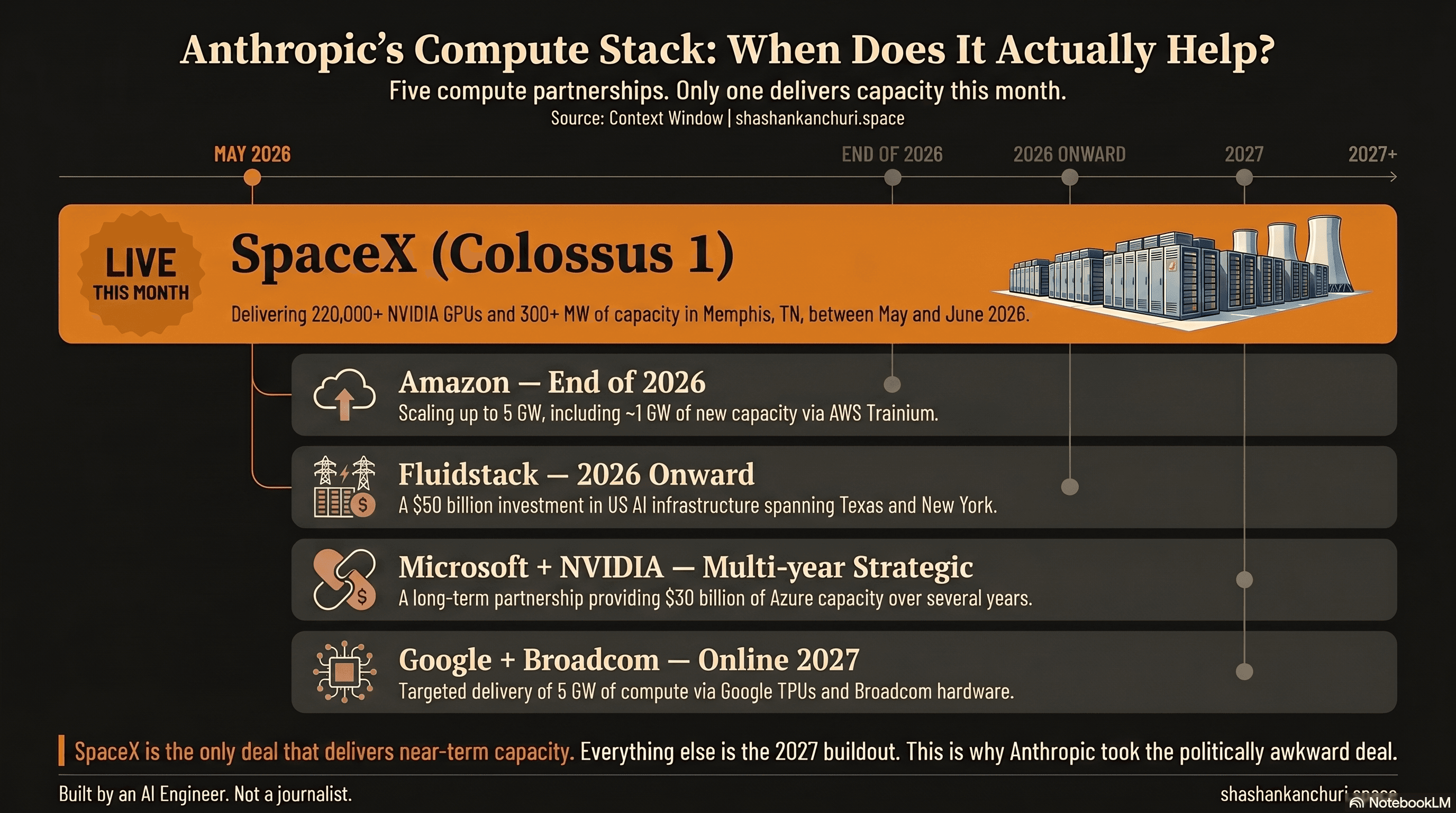
Anthropic's infrastructure agreements stack up as of today.
| Partner | Capacity | Timeline |
|---|---|---|
| SpaceX (Colossus 1) | 300+ MW, 220,000+ GPUs | Within the month |
| Amazon | Up to 5 GW (incl. ~1 GW new, Trainium 2/3) | End of 2026 |
| Google + Broadcom | 5 GW (Google TPUs via Broadcom) | Coming online 2027 |
| Microsoft + NVIDIA | $30B Azure commitment, up to 1 GW | Multi-year |
| Fluidstack | $50B US AI infrastructure (TX + NY) | Multi-year, 2026 onward |
Look at the timeline column. Everything except SpaceX is measured in months-to-years, in ramp curves, in “up to” ceilings that depend on chip production and construction schedules. SpaceX is the only row that says “within the month.” The facility already exists. The GPUs are already racked. The power is already connected.
Mapped against a deployment timeline, the near-term gap becomes visible in a way the table can't quite capture. Anthropic didn't pick SpaceX because of shared values. It picked SpaceX because SpaceX is the only partner that could move fast enough.
That insight is the deal.
The Forced Marriage
Let's be direct about incentives.
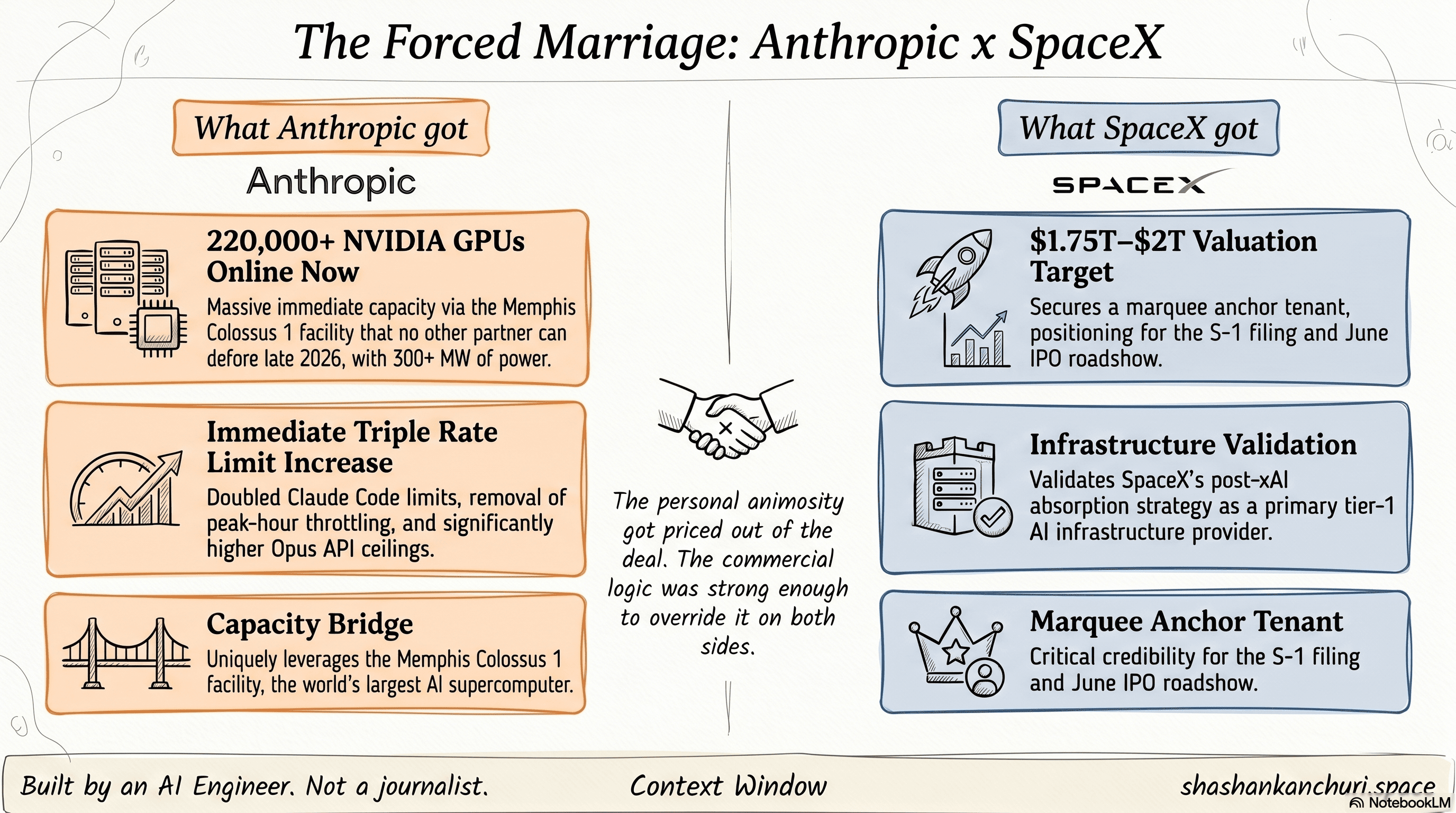
What Anthropic got: The only available block of near-term GPU capacity at scale that doesn't require building new facilities or waiting for next-generation chip production. When you need 220,000 GPUs online in 30 days and your existing partners are all operating on 2026-or-later timelines, your supplier options collapse quickly. Anthropic ran the analysis, found one viable counterparty, and signed.
What SpaceX got: Something more valuable than the revenue: a named, marquee anchor customer in its customer list ahead of a historic IPO.
The timeline here matters. SpaceX filed confidentially with the SEC on April 1, 2026. The public S-1 is expected in late May, around the 15th to 22nd. The roadshow is targeting the week of June 8. The company is aiming for a $1.75 to $2 trillion valuation, which if achieved would make it the largest IPO in history, and a $75 billion raise. For a company positioning Colossus as AI infrastructure for third parties, having Anthropic, the lab behind Claude, as a signed customer is not a line item. It's a narrative.
What the SpaceX-xAI absorption enabled: This deal was only structurally signable because SpaceX absorbed xAI in February 2026. Colossus 1 was built by xAI. Pre-merger, Anthropic would have been negotiating with one of its direct competitors for GPU access. Post-merger, it's negotiating with an infrastructure company that happens to own a data center originally built for a competitor's training runs. The corporate restructuring created the commercial opportunity.
Musk's reversal: After the deal was announced, Musk posted that he had done a “background check” on the Anthropic team and “no one set off my evil detector.” Read that charitably, as a genuine if oddly phrased expression of rapprochement, and you still have to acknowledge that three months of calling a company evil is not a typical precursor to a major commercial agreement. Read it less charitably and it looks like the kind of thing you say when a deal is signed and the press release is already out, and you need to explain the contradiction to your own followers.
The math between these two companies worked. The personal relationship is, at best, a work in progress. The asymmetry between what each party brought and what each party took is the part worth sitting with.
The Uncomfortable Parts
I want to be honest about three things that don't resolve cleanly.
The Memphis environmental record. Colossus 1 operates in South Memphis, a majority-Black community that has been fighting air quality issues for years before xAI showed up. The facility ran 35 gas turbines without proper air permits before Shelby County Health Department belatedly approved them in July 2025. Community opposition was significant enough to fill a 7-hour public hearing in December 2025. A February 2026 study by the Southern Environmental Law Center found that xAI's proposed 41-turbine gas plant at a nearby Southaven site would cause tens of millions of dollars in annual health damages to surrounding communities. Anthropic published a commitment in February 2026 to cover electricity price increases that its own data centers impose on consumers. The Memphis facility is not owned by Anthropic, but Anthropic's dollars are now flowing through it. Whether the electricity-price commitment extends to the people downwind of Colossus 1 is an open question, and it's a fair one to ask.
The political volatility. Anthropic is currently in an active standoff with the Trump administration's Department of Defense. Defense Secretary Pete Hegseth declared Anthropic a supply chain risk to national security in February 2026, which restricts military contractors from doing business with the lab. Amodei was publicly trying to “deescalate” as of early March. Elon Musk is a vocal Trump supporter with significant influence in the current political moment. I have no idea how these threads interact with a commercial compute agreement, but anyone who tells you it's irrelevant is not being serious.
Concentration risk. 220,000 GPUs in a single Memphis facility, owned by a partner with clear political exposure and a complicated personal history with your CEO, is a lot of inference capacity to put in one place. Anthropic's multi-partner strategy exists precisely to avoid this kind of dependency. The SpaceX deal solves the near-term capacity gap; it also adds a meaningful single point of failure that didn't exist before.
None of this invalidates the deal. All of it is worth tracking.
AI Engineer's Take
I use Claude Code every day. I have structured my work around its session windows, moved tasks to off-peak hours to avoid throttling, and more than once watched a promising agentic run die because it hit the wall at the wrong moment. The rate limit increases that went live on May 6 are not a minor UX improvement. They change what I can actually build.
Here's what I think is real.
The capacity unlock makes the agentic primitives operational. Routines, Managed Agents, multi-agent orchestration: these are not toys. They're genuinely powerful tools for anyone building software systems that need to reason across long contexts, spawn subagents, and iterate without constant human checkpoints. But they are only useful if the infrastructure sustains them. The five-hour limits were a hard ceiling on ambition. Doubling them is not just arithmetic. It is the difference between the architecture being viable or being a demo.
Multi-vendor hardware diversity is no longer optional. Anthropic now spans AWS Trainium chips, Google Cloud TPUs, NVIDIA H100/H200/GB200s across Colossus, and Microsoft Azure. From an ML infrastructure perspective, that's a genuinely different kind of resilience than anything Anthropic had six months ago. It also means the training and inference stack has to work across meaningfully different hardware architectures. That's hard engineering. I'm curious whether we'll see any of this surface in model performance or latency characteristics over the next few months.
The orbital compute story is a sideshow. Multiple gigawatts of inference capacity in orbit, served via Starlink, is a genuinely interesting long-term idea, especially for latency-sensitive inference in places with poor terrestrial connectivity, or for workloads where you actually want physical separation from national infrastructure. SpaceX has filed FCC paperwork for the satellite constellation that would enable this. None of it is operational. None of it is priced. I'd treat the orbital compute angle as a 10-year vision and update my views when there's a signed contract.
The unanswered question is execution. 220,000 GPUs is a lot of hardware to bring online in 30 days. Even in a facility that already exists and is already powered, integrating that scale of inference capacity into Anthropic's serving infrastructure cleanly, without introducing new latency tails, without service disruptions during migration, without creating novel failure modes, is not a trivial operation. The rate limit increases went live on May 6, the day of the announcement, which means Anthropic had some capacity in hand before the deal closed. But “within the month” for the full 300+ MW block is an aggressive timeline. I'm watching for any degradation in Claude reliability over the next few weeks. That'll be the leading indicator of whether the migration is going well.
What to Watch
Three things I'll be tracking.
The SpaceX S-1 disclosures. When the public prospectus drops, expected between May 15 and May 22, it will contain deal terms, customer concentration data, and revenue projections for the Colossus infrastructure business. The Anthropic agreement will almost certainly appear as a material contract. That's when we'll know what “all the compute capacity” actually costs per megawatt-hour, whether there are exclusivity clauses, and how SpaceX's banking team chose to frame Anthropic's role in the Colossus business model.
Whether the Musk-Amodei détente survives. The next AI safety controversy, the next policy dispute, the next time Anthropic declines a government request that Musk publicly supports: the détente will be tested by the first news cycle that puts them on opposite sides of something that matters. A vendor relationship can survive political disagreement. It can sometimes survive public insults. But it requires both parties to decide the commercial value outweighs the friction. Watch for whether either side revisits that calculation.
Whether Anthropic extends its electricity commitment to Memphis. Anthropic's February 2026 pledge covers consumer electricity price increases from Anthropic's own data centers. Colossus 1 is not Anthropic's data center; it's SpaceX's. But Anthropic is now its anchor customer. The community advocacy groups in South Memphis have been vocal and organized. Whether Anthropic engages with the Memphis situation, or treats the facility-ownership distinction as a clean excuse, will say something real about whether the electricity commitment is a policy or a PR move.
Built by an AI Engineer. Not a journalist.