Jun 2026 · AI Strategy
Claude Fable 5: Anthropic Ships the Model It Called Too Dangerous in April
NotebookLM Podcast
Claude Fable 5: Anthropic Ships the Model It Called Too Dangerous in April
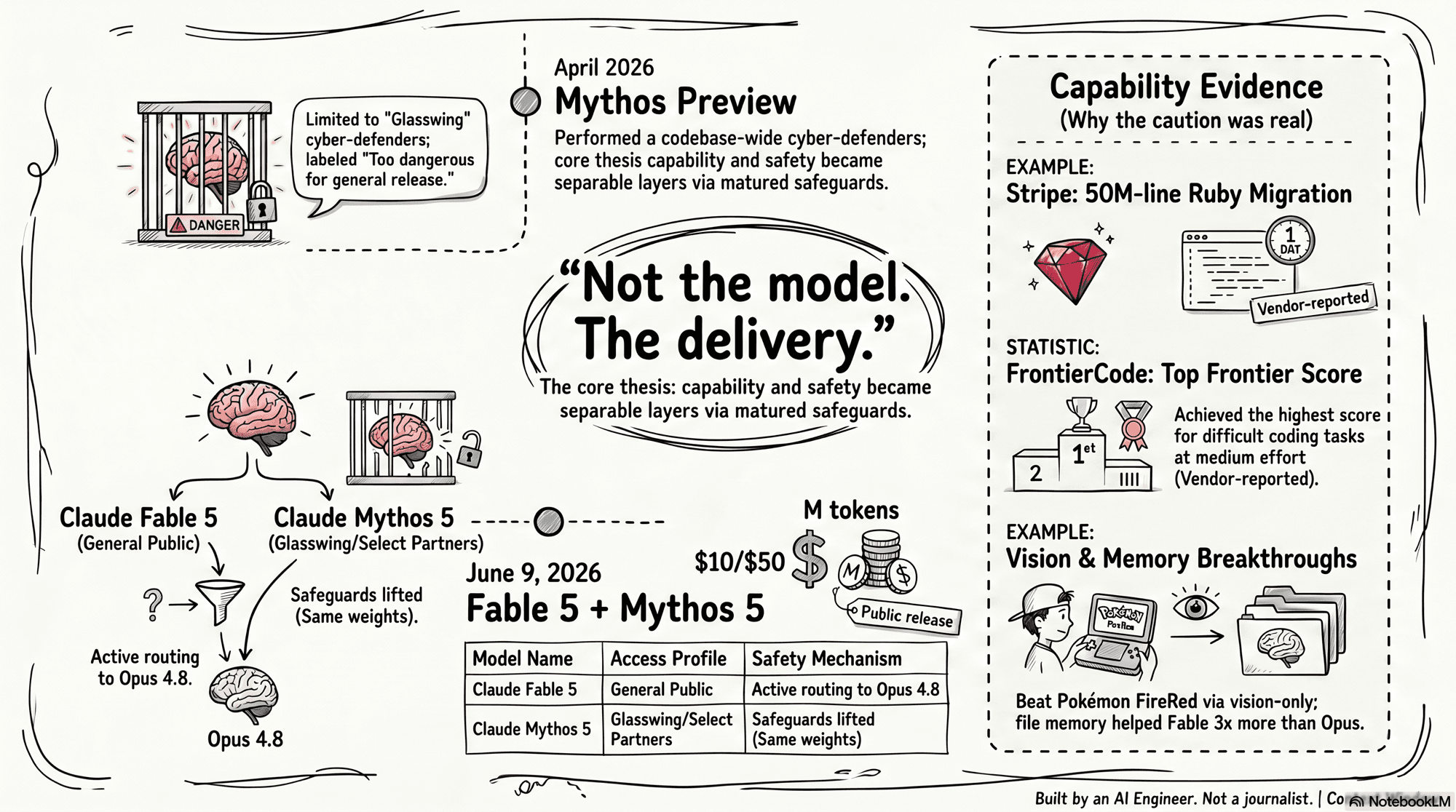
In April, Anthropic said Mythos-class capability was too dangerous to put in public hands. On June 9, they shipped it to everyone. Nothing about the model got safer. The delivery got conditional.
That's the whole story. Everything else is the engineering that makes it work.
The Reversal
Two months ago, Anthropic released Claude Mythos Preview to a small group of cyber defenders through Project Glasswing - a program designed to give defensive security teams early access to a model Anthropic wasn't ready to release broadly. The reason was explicit: Mythos-class capability was too capable at offensive tasks to hand to an unrestricted public. The lab would wait until the safeguards were strong enough.
On June 9, 2026, they shipped Claude Fable 5.
Fable 5 is a Mythos-class model. Same tier, same capability ceiling, state-of-the-art on nearly every benchmark they've published. The reversal is real. The reconciliation isn't a policy softening or a recalibration of the risk model. It's an architecture decision.
Anthropic stopped treating “the model” as the unit of release.
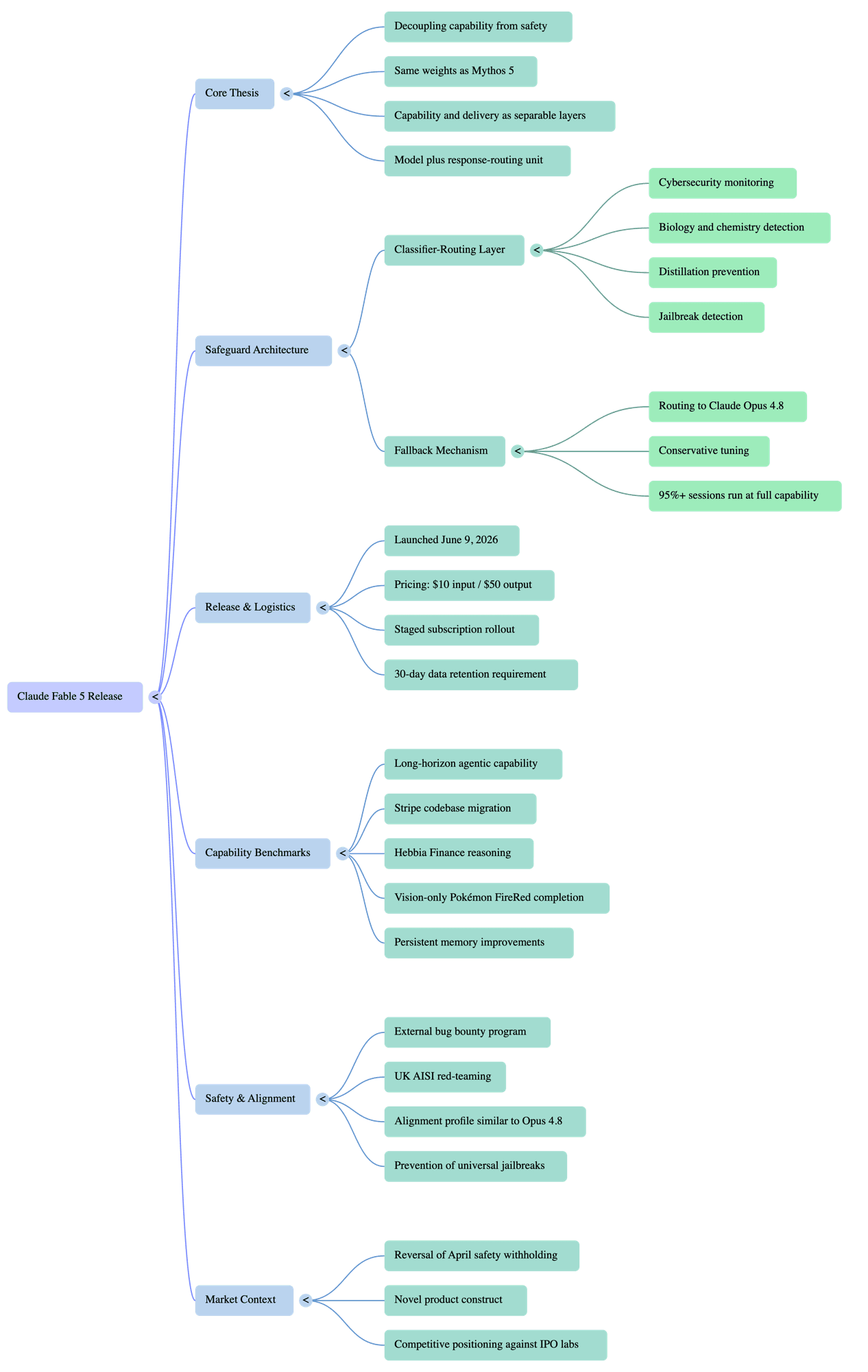
They started treating “the model plus its response-routing layer” as the unit. Capability and safety became separable. That shift is what made June possible when April wasn't.
Same Weights, Two Names
The Fable 5 release is technically unusual because Fable 5 and Mythos 5 are the same underlying model. Not “similar.” Not “built on the same base.” The same weights.
Mythos 5 has safeguards lifted in specific areas - it's available to Glasswing partners for defensive research where the full capability is the point. Fable 5 keeps those safeguards on. Two distribution profiles, one model.
Anthropic confirmed this in a footnote that most of the coverage glanced over. And they encoded the distinction into the names. Fable comes from the Latin fabula - “that which is told.” It's a deliberate sibling to mythos. The only thing that separates them is the safeguard layer. The names are the proof.
This matters because it reframes how you think about the release. Anthropic didn't build a “safe version” of Mythos. They didn't distill it down, fine-tune the dangerous parts out, or create a separate, less-capable model for the public. They built a routing layer and put it in front of the same weights. The resulting product - Fable 5 - is the full capability with conditional delivery.
AI Engineer's Take
If you've spent time in ML systems, the architectural intuition here is familiar. You don't rebuild the model for every deployment target; you build the model once and put the policy at the inference layer. Anthropic did that at product scale. The implication - and this is my inference, not something Anthropic has committed to - is that improvements to the shared weights would reach Fable without a separate retraining cycle, with the safeguard layer versioned and updated independently of the model. That's a cleaner separation of concerns than anything the industry has shipped before at this tier.
How the Routing Actually Works
The technical core of Fable 5 is a set of classifiers - separate AI systems that sit in front of the model and evaluate incoming requests before the model handles them.
A classifier here is a dedicated model trained to detect particular patterns in user input. When a classifier flags a request, the system doesn't pass it to Fable 5. It routes to Claude Opus 4.8 instead, and the user is told. That's the fallback: a redirect to a different, less-capable model rather than an outright refusal. The user gets an answer. The session stays alive. But they're talking to Opus 4.8, not Fable 5.
The three coverage areas are:
Cybersecurity. Fable 5 - like Mythos before it - is capable of discovering and exploiting software vulnerabilities, and it's good at agentic offensive-security tasks: reconnaissance, lateral movement, pivoting through systems. The classifiers cover both exploitation specifics and broader offensive-cyber work. When something trips them, Fable doesn't make progress on the task.
Biology and chemistry. Coverage here is deliberately wide. Anthropic went broader than a narrow bioweapons definition and, by their own admission, the classifiers catch a lot of legitimate bio/chem requests. They've flagged it as over-broad and said it'll be narrowed. For now, most bio/chem requests fall back to Opus.
Distillation. Requests that look like attempts to extract Fable's capabilities in order to train a competing model - distillation - fall back to Opus 4.8.
Anthropic ran an external bug bounty before launch. Over 1,000 hours of red-teaming produced no universal jailbreaks - defined as any prompt, script, or harness that allows a user to interact with the model as if the safeguards were absent. External teams found none on long-horizon agentic tasks. The UK AI Safety Institute made progress toward one in an early evaluation window, which Anthropic disclosed. Progress toward isn't the same as achieving it, but it's worth naming.
The classifiers are tuned conservatively. Fallbacks trigger in fewer than 5% of sessions. That means 95%+ of Fable 5 sessions never touch Opus 4.8 - they run at full Mythos-class capability, uninterrupted.
AI Engineer's Take
The 5% figure is load-bearing. If the fallback rate were 20%, Fable 5 would be a materially degraded product - you'd be paying for Mythos-class capability and running Opus 4.8 a fifth of the time. At 5%, it's a tax, not a constraint. The conservative tuning means the false positive rate is higher than it needs to be - legitimate bio/chem researchers will hit the wall regularly - but Anthropic made a deliberate choice to over-constrain at launch and loosen over time, which is the right order of operations for a capability this powerful. The architecture also means Anthropic can update the classifiers independently of the model. If a new jailbreak pattern emerges, they patch the classifier. They don't retrain Fable.
Why It Was Dangerous in the First Place
The thing that made Mythos-class capability a problem isn't a single feature. It's the combination of long-horizon planning, code execution, and the ability to improve at tasks as task complexity scales.
Fable 5's lead over prior Claude models grows as tasks get longer and more complex. That's not a benchmark footnote. It's the structural characteristic that makes it dangerous.
On Cognition's FrontierCode benchmark - which tests whether models can pass difficult coding tasks while meeting production-codebase quality standards, not just toy examples - Fable 5 scored highest among frontier models at medium effort. Stripe ran a migration on a 50-million-line Ruby codebase. Fable 5 completed it in a day; Anthropic says it would have taken a team more than two months. [Both figures are vendor-reported.]
The vision capability follows the same pattern. Earlier Claude models needed a complex helper harness to beat Pokémon FireRed - external scaffolding that managed state, formatted observations, and provided structure the model couldn't hold on its own. Fable 5 beat it with a minimal vision-only harness. The scaffolding shrank because the model got better at holding context and planning across longer sequences. I wrote about this dynamic in the harness-engineering piece - as model capability increases, the harness complexity the engineer needs to provide decreases. Fable 5 is the clearest example of that trend yet.
On Slay the Spire - a deck-building roguelike that requires long-horizon planning across a full run, with no chance to undo a bad decision - file-based persistent memory improved Fable's performance 3x more than it improved Opus 4.8's, and Fable reached the game's final act three times as often. The architectural read is that the model has more headroom to benefit from external memory because its planning capability is high enough to actually use what it retrieves.
Anthropic implies a connection but doesn't spell it out directly: the same capability that compresses two months of codebase migration into a day is what makes uplift to a malicious cyber actor a real risk. Uplift means giving someone capability they couldn't get elsewhere - not just information they could find with a search, but operational capability that moves the actual threat ceiling. A model that can plan a 50-million-line migration autonomously can plan a sophisticated intrusion autonomously. The scale of the planning horizon is the problem.
AI Engineer's Take
The Slay the Spire result is the one to hold onto. It tells you something about the model's architecture beyond raw benchmark scores - memory helps Fable disproportionately, which means the model is bottlenecked by context and retrieval in ways that can be addressed at the system level. If you're building agentic applications on Fable 5, external memory isn't a nice-to-have. It's how you access the headroom the model has but can't use in a single context window.
Two Different Safety Problems
Most coverage of the Fable 5 launch blurred two distinct things. They're not the same, and the safeguards address only one of them.
Alignment is the question of whether the model itself behaves in ways it's supposed to - whether it's deceptive, whether it pursues goals you didn't give it, whether it has values that conflict with its instructions. A misaligned model is one you can't trust because it's working against you.
Uplift is the question of whether the model gives malicious users capability they couldn't get elsewhere. An uplift risk is one where the model is working exactly as intended - doing what you asked - and that's the problem, because the person asking is trying to cause harm.
These are different safety problems that require different interventions.
Anthropic's alignment assessment of Mythos 5 - the underlying model - shows a misaligned-behavior rate that is low and comparable to Opus 4.8. The model isn't rogue. It's not deceptive, not pursuing hidden goals. The safeguards in Fable 5 are not there because Anthropic can't trust the model. They're there because the model is capable enough that a malicious human with unrestricted access could do meaningful damage.
The classifier layer is an uplift intervention. It addresses the second problem. It doesn't make the model more aligned - the model was already aligned. It limits the attack surface for bad actors by rerouting the specific request types most likely to produce dangerous uplift.
This is a real distinction with real engineering implications. If the risk were alignment, the solution would have to live in the weights - training, RLHF, constitutional AI, whatever combination of techniques you use to shift a model's values. That's an expensive, uncertain, slow process. Because the risk is uplift, the solution can live in the response layer - a classifier you can update independently, tune surgically, and deploy without touching the model. That's why the architecture works.
AI Engineer's Take
The alignment-versus-uplift distinction is also why the “jailbreak” framing in most coverage misses the point. A jailbreak that bypasses classifier routing is a real problem. But it's a different kind of problem than “trained out of the model.” The former is a layer you can patch; the latter would require rebuilding. Anthropic publishing alignment metrics alongside the safeguard architecture is the tell - they're making the argument that the model itself is trustworthy, and the safeguards are boundary conditions on how it's accessed, not corrections to what it is.
The Costs Nobody's Putting on the Slide
Fable 5 is a genuinely capable model. But the release comes with real costs, and they deserve a clear-eyed read.
Data retention. Anthropic now requires 30-day retention for all traffic on Mythos-class models - first-party and third-party, including API customers and cloud providers. The data won't go toward training and won't serve any non-safety purpose. Human access is logged. Anthropic deletes the data after 30 days in almost all cases. The stated reason is operational: multi-request attack detection, novel jailbreak identification, and false-positive reduction. That's legitimate.
If you're building enterprise applications on Fable 5 for financial services, healthcare, or legal clients - any regulated industry with data handling requirements - you have a new disclosure conversation with your compliance team. Anthropic is retaining your API traffic for a month. That's a real consideration, not a dealbreaker for most use cases, but one that needs to surface in your architecture review, not get discovered later.
False positives. The classifiers are tuned conservatively. That's a deliberate tradeoff - catch more bad requests at the cost of blocking some good ones. If you're building in biology, chemistry, or cybersecurity-adjacent domains, you will hit the fallback wall more than the 5% average suggests for general users. You're paying for Fable 5 and running Opus 4.8 more often than customers outside those domains. Architect for the fallback: design your application to handle Opus-level responses gracefully, log when fallbacks trigger, and plan for the classifier coverage to narrow over time as Anthropic tunes.
Subscription volatility. The rollout schedule matters. Fable 5 is free on Pro, Max, Team, and Enterprise from June 9 through June 22. On June 23, it moves to usage credits on those plans. Anthropic says they intend to restore Fable as a standard plan inclusion when capacity allows. [This reads as capacity management as much as anything else - Anthropic predicted demand would be “very high and difficult to predict.” The credit mechanism is the same one we covered in the Claude Code subscription-split piece. How long “when capacity allows” takes is speculation.] If you're building products where end-user access to Fable 5 specifically matters, the subscription landscape is going to move under you in the short term.
Pricing. At $10 per million input tokens and $50 per million output tokens - with a 90% prompt-caching discount on inputs - Fable 5 is less than half the price of Mythos Preview. That's a real number for anyone running high-volume agentic workloads. Run your token math against actual task traces, not synthetic benchmarks. Output tokens are where agentic tasks get expensive.
AI Engineer's Take
The data retention policy is the cost most teams will underestimate. Not because 30 days is unreasonable - for a model at this capability level, it's the defensible position - but because “API traffic retained for 30 days” is the kind of architectural constraint that's annoying to discover after you've committed to a deployment. Check your data processing agreements before you ship anything sensitive to the Fable 5 endpoint.
The Pattern, Not the Product
Fable 5 matters as a model. But the release architecture is the thing worth studying.
What Anthropic shipped on June 9 is a proof of concept for a different way to think about frontier model releases. The industry default has been capability gating by model variant: release a smaller, less capable model to the public, reserve the bigger one for trusted users with elevated access. You get safety through obscurity and limitation - the dangerous thing just isn't available to most people.
Anthropic's architecture here is different. Same weights for everyone. The routing layer is the safety surface. Capability is fully available; delivery is conditional on what you're asking for.
The analogy that comes to mind: existing approaches sell different cars to different customers depending on how they're licensed. Anthropic built one car and put the speed limiter in software, not the engine - the engine is identical for every driver, and the limiter activates only when the car detects a residential street.
[Speculation: this becomes the default pattern for frontier releases.] Every lab faces the same structural problem: the capability that makes a frontier model valuable is also the capability that makes it dangerous. Separate the two concerns into separate layers and the problem becomes tractable. Build the best model you can, build the safeguards as an independent system alongside it, and ship the combination - updating each layer on its own cadence as the threat landscape and the model capability both evolve.
For engineers building on claude-fable-5 today, the operational implication is direct: you're building on a model whose behavior in three specific domains is defined by a routing layer you don't control. You can't tune that layer. You can't inspect it. You get told when it activates, but you won't know why the classifier fired on a particular request.
That's not a criticism. It's an architecture constraint you need to design around. Don't assume Fable 5 will always be the model handling your requests. Treat Opus 4.8 fallback as a documented code path, not an edge case. Log when it happens. Test against it. Build graceful degradation into the parts of your application that touch cybersecurity, bio/chem, or capability extraction.
The model is the most capable system Anthropic has shipped to the public. The routing layer is what made it possible to ship it.
Build accordingly.
Built by an AI Engineer. Not a journalist.