Apr 2026 · AI Infrastructure
AI Is Teaching Quantum Computers How to Grow Up
NotebookLM Podcast
AI Is Teaching Quantum Computers How to Grow Up
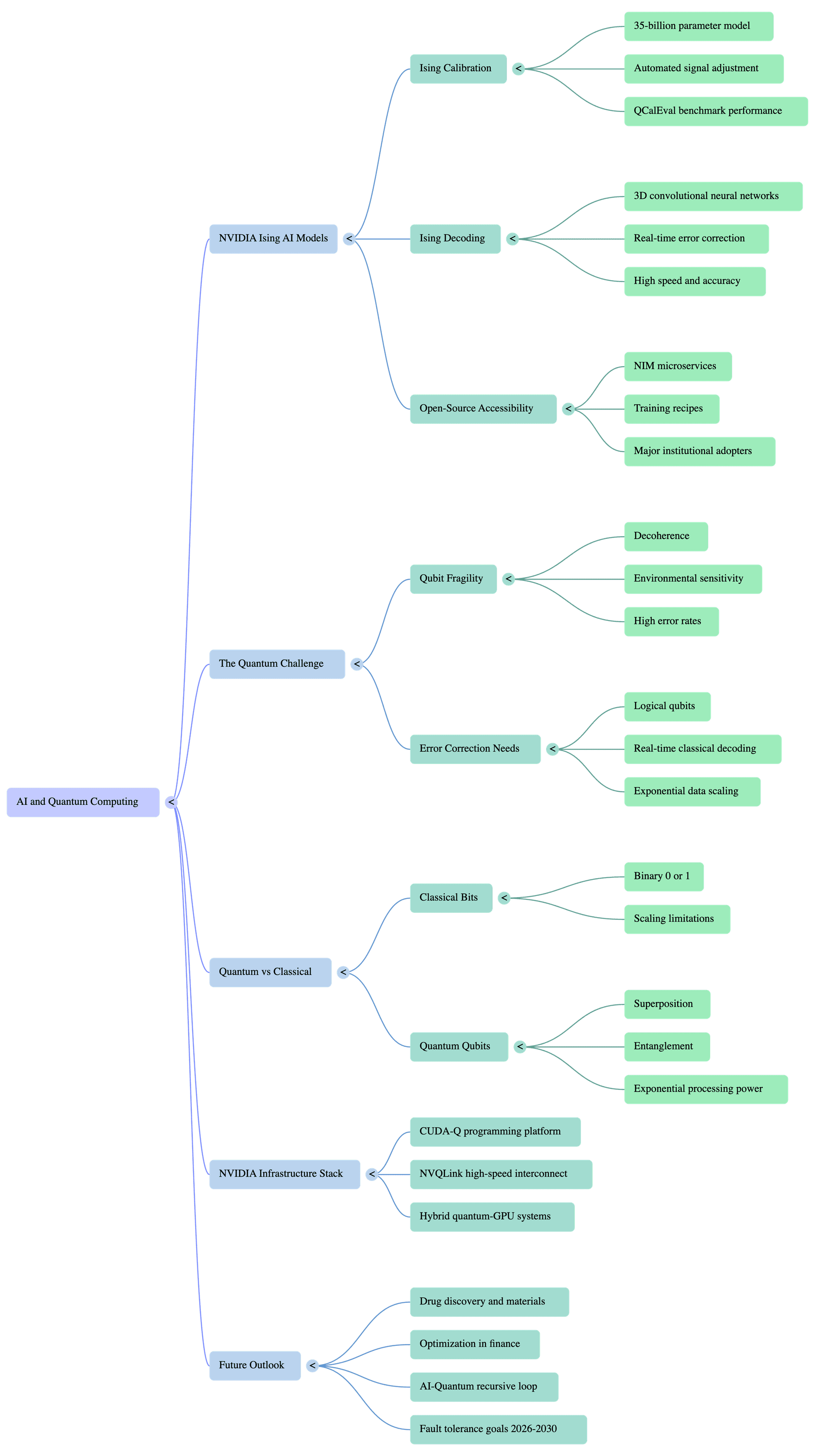
The most exciting AI models launched this week aren't for chatbots, coding, or image generation. They're for quantum computing. If you're an AI engineer who thinks quantum is somebody else's problem, this is the post where that changes.
On April 14, 2026, NVIDIA released Ising: the world's first family of open-source AI models built specifically to make quantum computers work. Not theoretical models. Not research proofs of concept. Production-ready AI tools that solve the two hardest problems standing between where quantum computing is today and where it needs to be. Harvard, Cornell, Sandia National Laboratories, Fermilab, IonQ, and a dozen other major institutions are already using them.
Let me explain why this matters, even if you've never thought about qubits in your life.
Simulating Nature With Nature's Own Rules
The physicist Richard Feynman had a deceptively simple idea back in 1982: if you want to simulate how the natural world actually works - how molecules fold, how drugs bind to proteins, how new materials behave - you need a computer that runs on the same physics as nature itself.
Classical computers can't do this well. Every laptop, phone, and GPU cluster on the planet stores information as bits, each one either a 0 or a 1. That's fine for most things, but simulating a single caffeine molecule with full quantum accuracy would require more classical bits than there are atoms in the observable universe. The math simply doesn't scale.
Quantum computers flip this around. Instead of bits, they use qubits, which can exist in a state between 0 and 1 simultaneously through a property called superposition. When multiple qubits interact through entanglement, they can represent and process an exponentially larger set of possibilities at once. This isn't just faster computing. It's a fundamentally different kind of computing, one that speaks the same language as chemistry, physics, and biology.
That's the promise. Drug discovery that takes months instead of decades. Materials that store energy better, conduct electricity with zero loss, or survive conditions that would destroy anything we can build today. Optimization problems in logistics and finance that currently take weeks solved in hours.
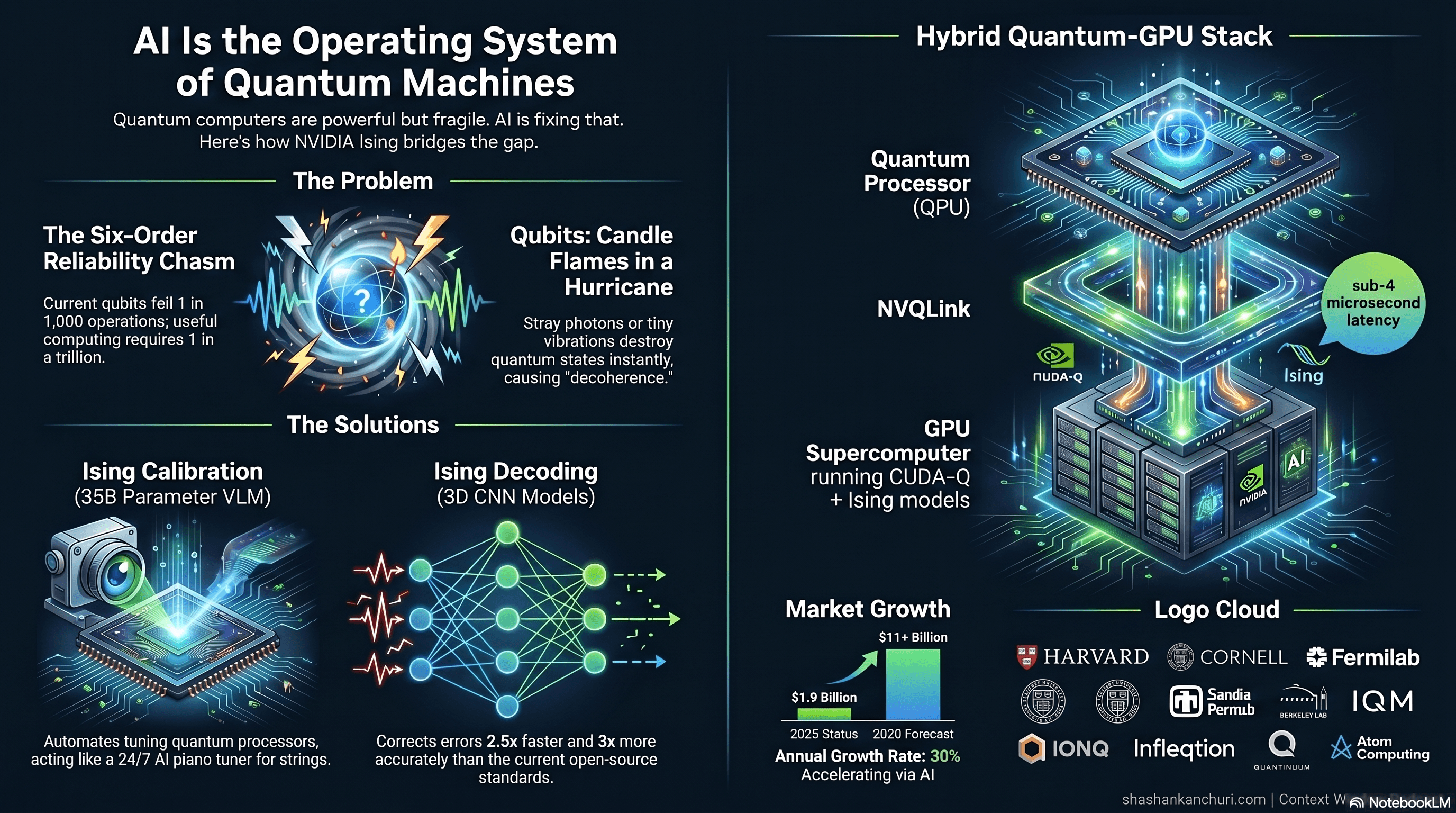
Google's researchers compared the current state of quantum computing to the Wright Brothers era of aviation. The first powered flight lasted 12 seconds and covered 120 feet. Nobody was booking transatlantic tickets. But the fundamental principle was proven. That's roughly where quantum is right now.
The Fragile Genius Problem
Here's what the hype cycle skips over: qubits are absurdly fragile.
A classical bit is bulletproof. Store a 1 on a hard drive, throw it across a room, and it's still a 1 when you pick it up. A qubit is the opposite. A stray photon, a vibration from a passing truck, a temperature fluctuation measured in millionths of a degree: any of these can destroy the quantum state instantly. This is called decoherence. It's the reason quantum computers operate near absolute zero inside shielded chambers that look like chandeliers from a cyberpunk cathedral.
The error rates tell the real story. Current quantum processors fail roughly once every 1,000 operations. Useful quantum computing needs failure rates closer to one in a trillion. That gap - six orders of magnitude - is the chasm the entire field has been trying to bridge for thirty years.
The solution is quantum error correction. Spread the information across multiple physical qubits to create a single, more reliable logical qubit. If one physical qubit gets corrupted, the others catch and fix the error. Google's Willow chip proved in December 2024 that this actually works. They demonstrated the first below-threshold error correction, where errors decreased as more qubits were added. A genuine milestone.
But here's the catch nobody talks about enough. Error correction requires a fast classical computer - a decoder - running alongside the quantum processor, processing massive error signals in real time. We're talking terabytes of data per second, with correction decisions needed in microseconds. As quantum systems scale from 100 qubits to thousands to eventually millions, the decoding workload grows exponentially. Traditional algorithms hit a wall.
You need something that can learn the complex, hardware-specific noise patterns of each individual quantum processor and adapt on the fly. Something that gets better with more data, handles messy inputs, and makes decisions at machine speed.
You need AI.
NVIDIA Ising: The AI Brain for Quantum Machines
This is where the story gets concrete. NVIDIA's Ising family includes two purpose-built models.
Ising Calibration
Ising Calibration is a 35-billion parameter vision-language model - the same architecture family behind image-understanding AI - fine-tuned to interpret measurements from quantum processors and automatically adjust the physical control signals (microwaves, lasers, electromagnetic pulses) that manipulate qubits.
Here's the analogy that makes this click: imagine a concert pianist who has to constantly retune their piano mid-performance. The piano has over 100 strings, each one affects all the others, and the temperature in the concert hall keeps changing. That's quantum calibration. It's been a tedious, manual, expert-intensive task since quantum computing began. Ising Calibration automates it entirely: an AI agent that monitors, interprets, and adjusts, 24/7, without human intervention.
On NVIDIA's new QCalEval benchmark - the first standardized test for quantum calibration AI - it outperformed Gemini, Claude, and GPT models.
Ising Decoding
Ising Decoding consists of two 3D convolutional neural network models that handle real-time error correction. One is optimized for speed, the other for accuracy. They process the syndrome data from the quantum processor and determine what went wrong: 2.5x faster and 3x more accurate than pyMatching, the current open-source standard.
Both models are fully open-source. They ship with training data, workflow recipes, fine-tuning guidelines, and NVIDIA NIM microservices for containerized deployment. Any quantum lab on the planet can download them, customize them for their specific hardware, and start using them today.
The adopter list reads like a who's-who of quantum research: Harvard, Cornell, Sandia National Labs, Fermilab, Lawrence Berkeley National Lab, UC Santa Barbara, IQM Quantum Computers, IonQ, Infleqtion, Atom Computing, Q-CTRL, the UK National Physical Laboratory, and Academia Sinica.
| Model | Architecture | Key Result |
|---|---|---|
| Ising Calibration | 35B VLM | #1 on QCalEval |
| Ising Decoding (Speed) | 3D CNN | 2.5× faster than pyMatching |
| Ising Decoding (Accuracy) | 3D CNN | 3× more accurate than pyMatching |
The Bigger Stack
Ising doesn't exist in isolation. It's one layer in a full architecture NVIDIA is building to fuse quantum and classical computing into a single system.
CUDA-Q
CUDA-Q is an open-source quantum programming platform. Write your application once, run it seamlessly across CPUs, GPUs, and quantum processors. It's qubit-agnostic, works with any hardware vendor, and already integrates with 75% of publicly available quantum processors. Think of it as the CUDA of quantum computing.
NVQLink
NVQLink is the physical interconnect: a high-speed bridge that couples quantum processors directly to GPU-powered supercomputers with sub-4 microsecond latency and 400 Gb/s throughput. Jensen Huang called it “The Rosetta Stone connecting quantum and classical supercomputers.” It's already deployed at nine U.S. national laboratories and supercomputing centers across Japan, Korea, the UK, and Europe. Quantinuum's Helios QPU recently used NVQLink to demonstrate the first real-time scalable decoding for quantum error correction. A world first.
The vision is clear. Every major scientific supercomputer becomes a hybrid quantum-GPU system. The quantum processor handles what it's uniquely good at: simulating quantum systems, exploring massive solution spaces. The GPU infrastructure handles error correction, calibration, data processing, and AI workloads. One unified system. Not two machines stitched together with duct tape.
Why AI Engineers Should Care
I build AI systems for a living - LLMs, RAG pipelines, agentic workflows. Here's why I'm paying attention to this.
Your GPU skills transfer. The same NVIDIA GPUs running your inference workloads will run quantum error correction and calibration. CUDA-Q is explicitly designed so that developers familiar with CUDA can write hybrid quantum-classical applications without learning an entirely new stack. The on-ramp already exists.
The recursive loop is coming. Quantum hardware could eventually generate high-quality training data for future AI models. AI makes quantum computers better. Quantum computers generate better data. That data trains better AI. That AI makes quantum computers even better. This is the kind of compounding improvement cycle that created the current AI explosion, and it's starting to form between AI and quantum.
The infrastructure playbook is familiar. NVIDIA is doing with quantum exactly what they did with AI. Open-source the foundational models. Build the hardware interconnects. Create the programming platform. Make yourself indispensable to every player in the ecosystem. If you've watched the CUDA-to-AI pipeline play out over the last decade, you're watching the same script applied to quantum.
The Honest Take
Fault-tolerant quantum computers capable of solving commercially relevant problems are still years away. The 2026-2029 window is when things get decisive. Google is targeting fault tolerance by the end of the decade, IBM is racing toward 200 logical qubits, and a dozen other players are pushing hard from different angles.
But the trajectory is unmistakable. The global quantum market hit $1.9 billion in 2025 and is growing at 30% annually. NVIDIA forecasts it will exceed $11 billion by 2030. The quantum workforce grew 14% last year alone. This isn't speculative. It's an active infrastructure build involving every major tech company and government on the planet.
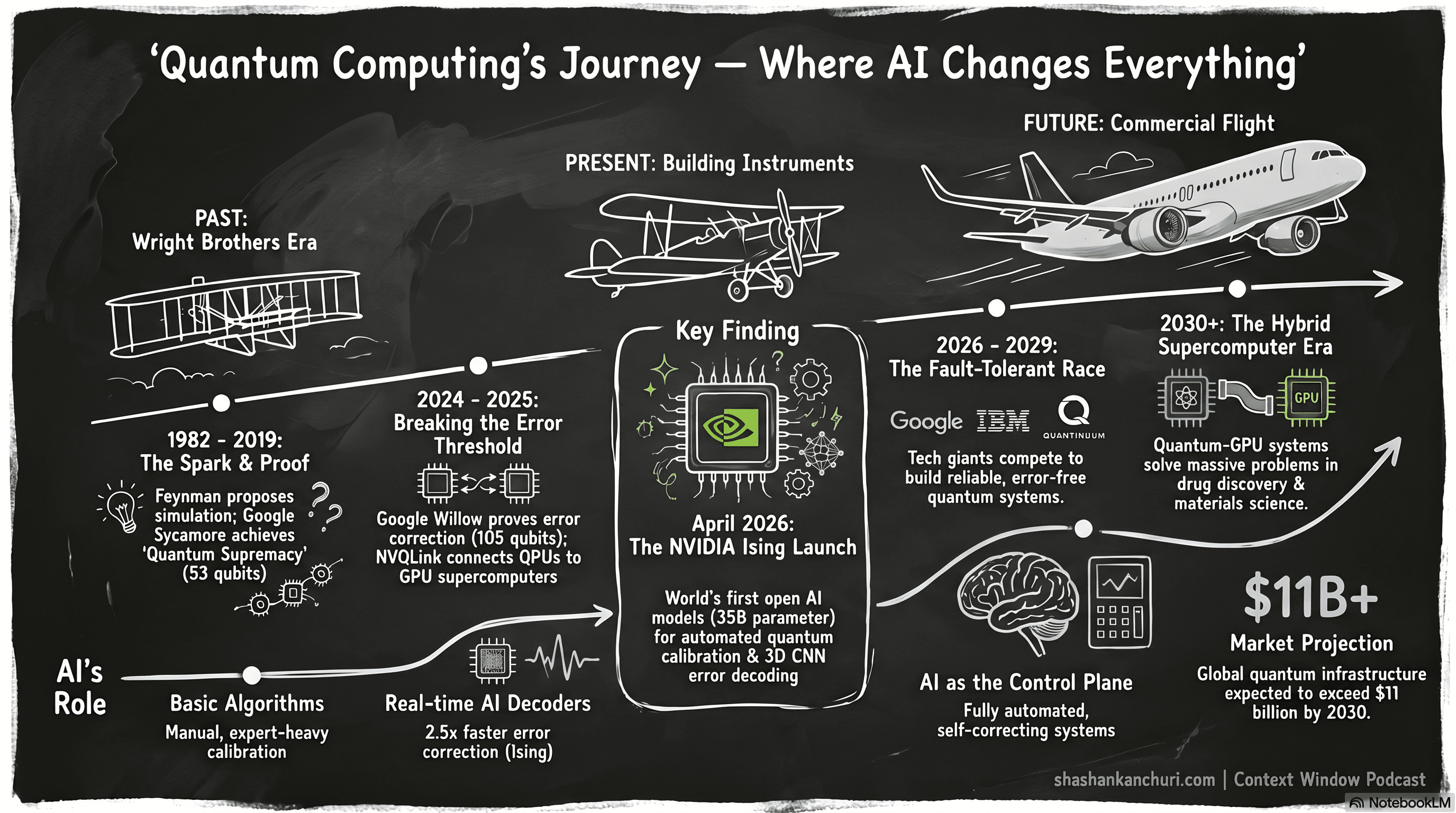
We're in the Wright Brothers era of quantum computing. The planes are small, the flights are short, and nobody's booking transatlantic tickets yet. But someone just built the first real flight instruments. And they gave them away for free.
Built by an AI Engineer. Not a journalist.