Jun 2026 · AI Infrastructure
The Money Is Going in a Circle
What AI's capital frenzy actually looks like once you follow the dollars, why it looks different from inside the stack, and what happens if the circle breaks.
NotebookLM Podcast
The Money Is Going in a Circle
A trillion-dollar valuation and a fourteen-billion-dollar annual loss are describing the same company in the same year. OpenAI is on track to lose roughly $14 billion in 2026, close to triple its 2025 losses, even as it projects $100 billion in revenue by 2029. Both numbers are real. The question worth asking is not how one company survives that gap. It is how an entire industry decided the gap was worth funding at a scale the world has never seen, and whether the ground underneath that decision is solid.
I build on this infrastructure for a living, so this is not an investor's curiosity for me. It is the floor I stand on. Here is what it looks like once you stop reading the headlines and start following the dollars.
The surface
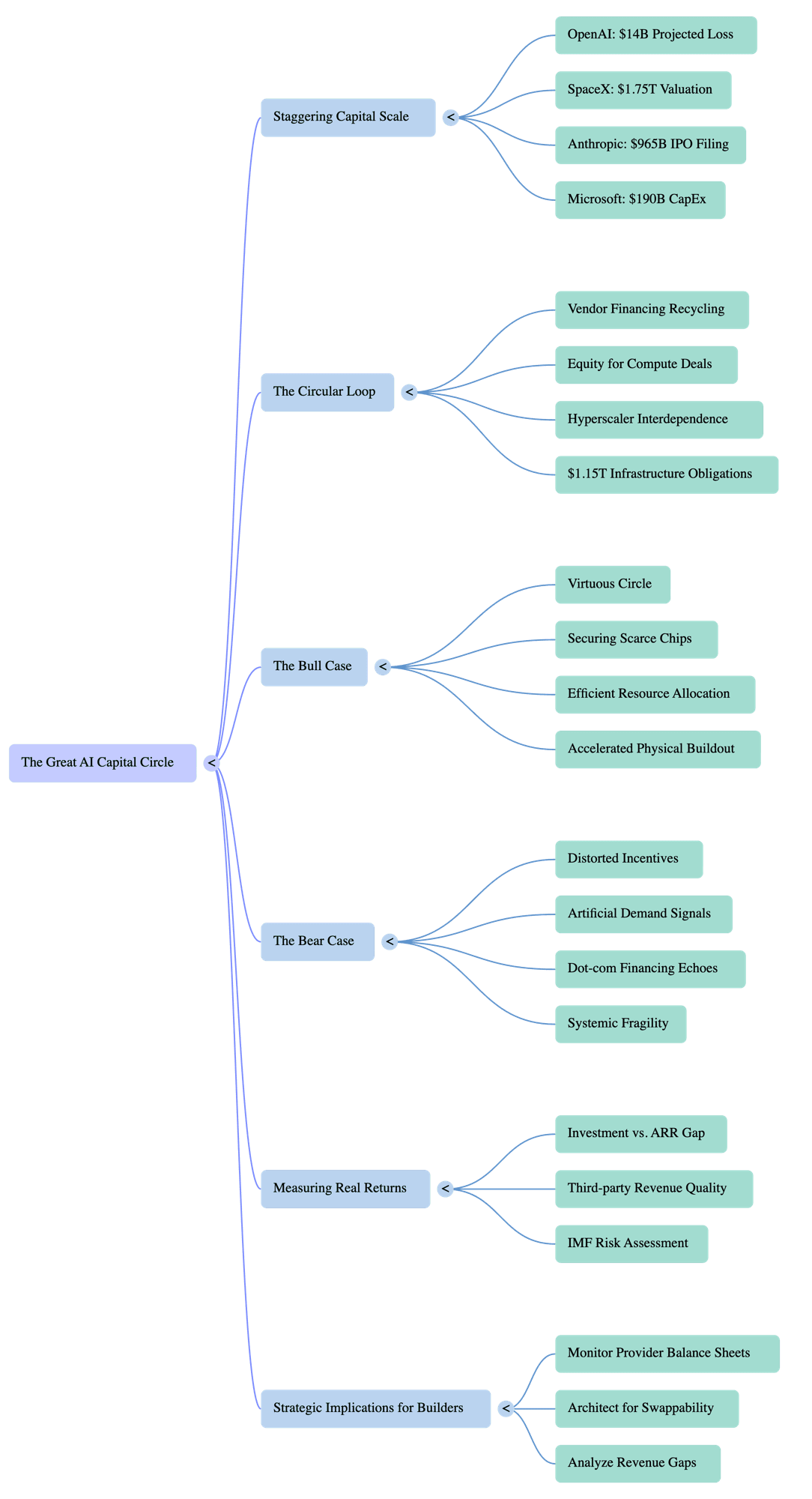
Start with the headline figures, because they are staggering. SpaceX went public in June in one of the largest IPOs in history, targeting a raise near $75 billion at a valuation around $1.75 trillion. Anthropic closed a round at a $965 billion valuation and has confidentially filed for its own IPO. Microsoft now expects 2026 capital expenditure to reach about $190 billion. These are not growth-stage bets. They are the kind of capital commitments that used to belong to energy companies and national governments.
But the scale is the easy part of the story. The interesting part is not how big the numbers are. It is how the money moves.
The loop
Trace the dollars and they do not run in a straight line from investors to companies to products. They circle a small group of firms that keep showing up on multiple sides of the same deals.
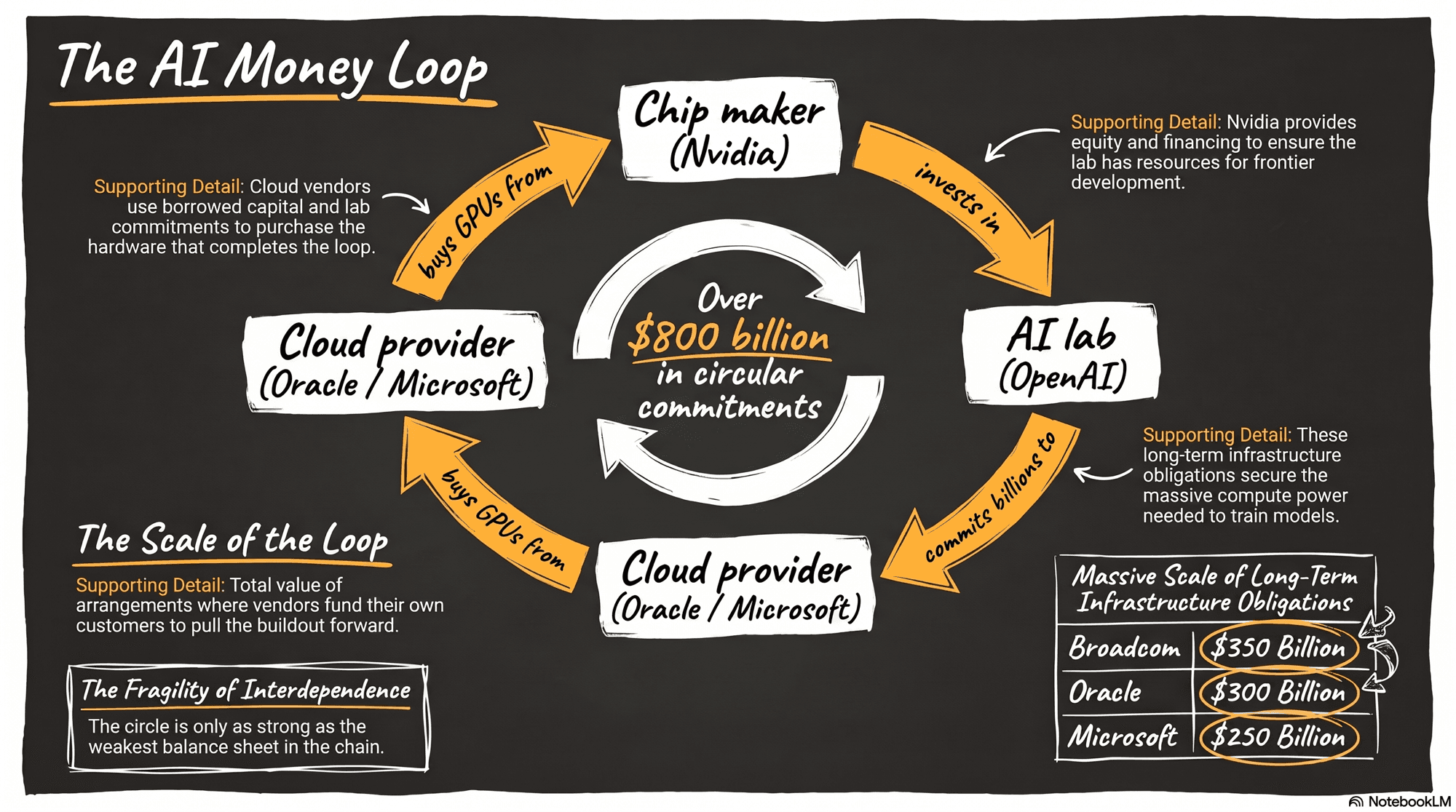
   Chip maker  ----invests in---->  AI lab
       ^                              |
       |                              | commits $$ to
   buys GPUs                          v
       |                         Cloud provider
       +-------------------------------+
Nvidia takes equity in an AI lab. The lab uses that money, plus its compute deals, to buy GPUs, most of them from Nvidia. Nvidia's revenue rises (its most recent quarter came in around $81.6 billion, up roughly 85 percent year on year), and it recycles the proceeds into equity in more AI companies, who buy more GPUs. The same loop runs through the hyperscalers: Microsoft owns roughly a quarter of OpenAI, and OpenAI has committed about $250 billion right back to Azure.
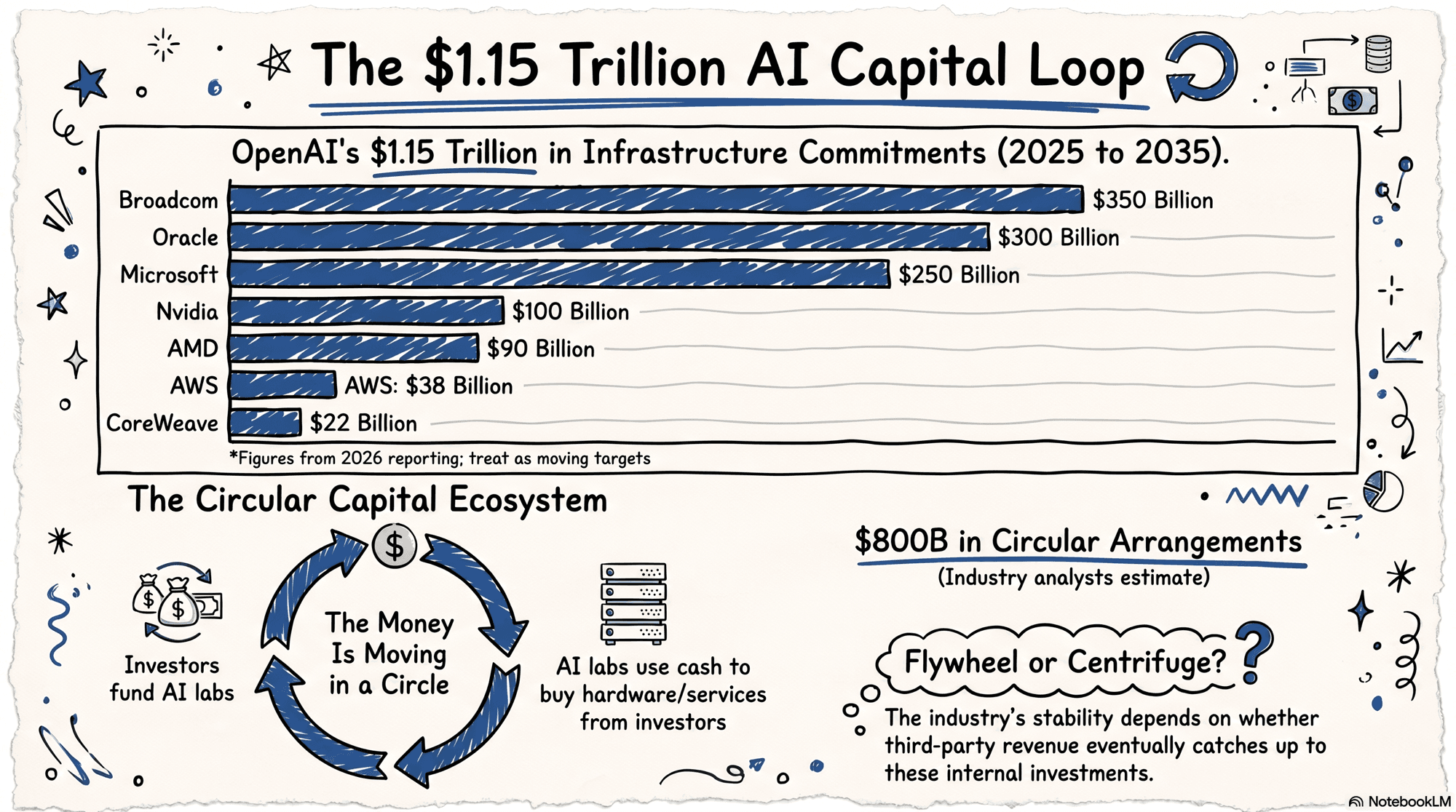
The commitments are where it gets dizzying. OpenAI has reportedly lined up around $1.15 trillion in infrastructure obligations across seven vendors between 2025 and 2035: Broadcom near $350 billion, Oracle $300 billion, Microsoft $250 billion, Nvidia $100 billion, AMD $90 billion, AWS $38 billion, and CoreWeave $22 billion. Nvidia's own letter of intent to invest up to $100 billion in OpenAI is tied to deploying at least ten gigawatts of its systems. Analysts now put the total of these circular arrangements north of $800 billion.
The bull case
It would be lazy to call this a scam, so steelman it first. Building frontier AI is extraordinarily expensive, and the best chips are still scarce. In that kind of market, you do not just place an order and wait. You lock in supply by pairing long-term buying commitments with financing. Janus Henderson described the wave of deals as a virtuous circle that lines up suppliers, builders, and customers to meet exploding demand for compute. By baking spending into investment deals, the players bypass slower fundraising and pull the physical buildout forward by years. If demand is real, this is just efficient capital allocation under scarcity.
The bear case
The problem is what happens to incentives when a vendor funds its own customer. The pressure shifts toward booking the deal rather than testing whether anyone downstream actually needs the capacity. Each leg of the loop can record revenue or backlog from the same underlying dollar, which means demand can look larger than it is. The echoes of dot-com vendor financing are hard to miss.
You can see the fragility under stress. When reporting earlier this year suggested Nvidia's OpenAI investment had stalled, investors immediately connected the dots: Oracle was borrowing tens of billions to build servers largely for OpenAI, so if Nvidia pulled back, could OpenAI still pay Oracle? Oracle's stock fell before the company issued a defensive statement. The circle is only as strong as the weakest balance sheet in it.
Are the returns real
Here is the signal I would watch. Microsoft spent about $97 billion over four quarters while its AI services generated roughly $37 billion in annual recurring revenue. That gap is not damning on its own, but it keeps the return-on-investment question open. The IMF flagged AI investment reassessment as a downside risk in its spring outlook, and investors are starting to do something sensible: separating revenue earned from third parties from revenue paid by companies the supplier just invested in.
An AI engineer's take
Now the part most coverage skips, because most coverage is written by people who do not ship on this stack.
Every API call you make is priced inside this structure. When you budget a feature at a few dollars per million tokens, you are not paying the true cost of running that model. You are paying a number that capital is currently holding down. Frontier inference at today's prices is subsidized, directly through investment dollars and indirectly through providers racing for market share before the music slows. That is great while it lasts. It also means your unit economics are sitting on someone else's balance sheet, and you did not sign that loan.
So a few things that read as paranoia in a planning meeting are actually just engineering hygiene now.
Treat the model provider as a dependency, not a foundation. The moment your product assumes one vendor's pricing, latency, and availability are permanent, you have coupled your survival to their funding round. Put an abstraction layer between your application and whatever model answers the call. Make the provider a config value, not an architectural assumption. I would rather eat a small abstraction tax today than rewrite my serving path the week a price sheet doubles.
Watch availability, not just price. We already got a preview of what gated compute feels like. When frontier models get pulled, throttled, or restricted to approved partners, the bottleneck is no longer your code, it is who is allowed to run what. If your roadmap depends on a specific top-tier model being reachable on demand, that is a single point of failure dressed up as a feature.
Efficiency is leverage, and it is about to matter more, not less. Quantization, distillation, smaller fine-tuned models, smarter routing, caching: these used to be optimizations you reached for when the bill got scary. In a world where the subsidy on frontier inference could thin out, the team that can hit acceptable quality on cheaper compute is the team that keeps its margins when everyone else's costs reset. The boring inference work is the hedge.
AI Engineer's Take
The uncomfortable summary: the capital frenzy is quietly underwriting your demo. Build as if it will not always.
What happens if the loop breaks
“Breaking” is not one event, it is two very different ones.
The sharp version is a credit event. One major leg pulls financing, or one large lab cannot meet a payment on those trillion-dollar commitments. Because the same dollar sits on multiple balance sheets, the failure does not stay contained. A funding pullback at the lab becomes a revenue hole at the cloud provider, which becomes a demand shock for the chip maker, which becomes a stock move that drags index funds most people did not know were this exposed. The dot-com vendor-financing collapse is the closest historical rhyme, and it was not gentle.
The slow version is quieter and, in my view, likelier. Demand keeps growing, just not fast enough to justify the spend. The return-on-investment gap refuses to close. Capital does not flee, it tightens: fewer mega-rounds, harder questions about real third-party revenue, valuation compression rather than collapse. The buildout slows from a sprint to a walk.
Either way, here is what it would mean for the rest of us.
Compute could get cheaper, eventually. This is the counterintuitive part. After the dot-com bust, the over-built fiber did not vanish. It got bought for cents on the dollar and powered the next decade of the internet, including the streaming and cloud era that made the original bet look smart in hindsight. A glut of data centers and depreciating GPUs would be painful for the people who financed them and a gift to the builders who come after. Cheap, abundant compute is how a bubble's wreckage becomes a platform.
Prices could spike before they fall. In the short window where subsidies thin out but cheap surplus capacity has not hit the market yet, token prices could rise. That is the squeeze the efficiency work above is meant to survive.
Consolidation. Fewer independent frontier labs, more of them absorbed into the companies that own the compute and the capital. We have already watched that begin. The result is a more concentrated set of model providers, which is exactly why swappability stops being a nice-to-have.
Open weights get more important. When frontier access is expensive, restricted, or unreliable, the gravity shifts toward open-weight models you can run yourself. A broken loop accelerates that shift, and it rewards the people who already know how to serve a model rather than just call one.
The job market splits. The froth-funded layer, roles that exist because money was cheap, thins out first. The durable layer, people who build real products that real users pay for on top of this infrastructure, gets more valuable, because the question quietly changes from “who can raise” to “who can ship something worth paying for.”
AI Engineer's Take
And the most important point: the capability is real even if the capital structure is fragile. The models work. The productivity is not imaginary. What is uncertain is the financing scaffolding wrapped around them, not the technology underneath. If the loop breaks, AI does not disappear. The way we paid for its first few years does.
The close
The money is moving in a circle. Whether that circle is a flywheel or a centrifuge is the most important open question in the industry, and you do not need a hedge fund to watch the dials.
So three habits worth keeping.
Read the infrastructure providers' balance sheets, not just the model release notes. Treat every single provider as swappable, and architect so you can move. And when a new mega-deal gets announced, look for the gap between the backlog number and recognized third-party revenue, because that gap is the whole story.
Build like the capability is permanent and the prices are not. That is the posture that survives either ending.
Built by an AI Engineer. Not a journalist.