Apr 2026 · AI Research
TurboQuant: How Google just made AI 6x cheaper to run, and why you should care
NotebookLM Podcast
TurboQuant: How Google just made AI 6x cheaper
You've been optimizing the wrong thing.
Everyone's focused on model size, cutting parameters, distilling weights, squeezing networks into smaller shapes. But if you're running LLMs in production today, the real memory killer isn't the model. It's the model's short-term memory.
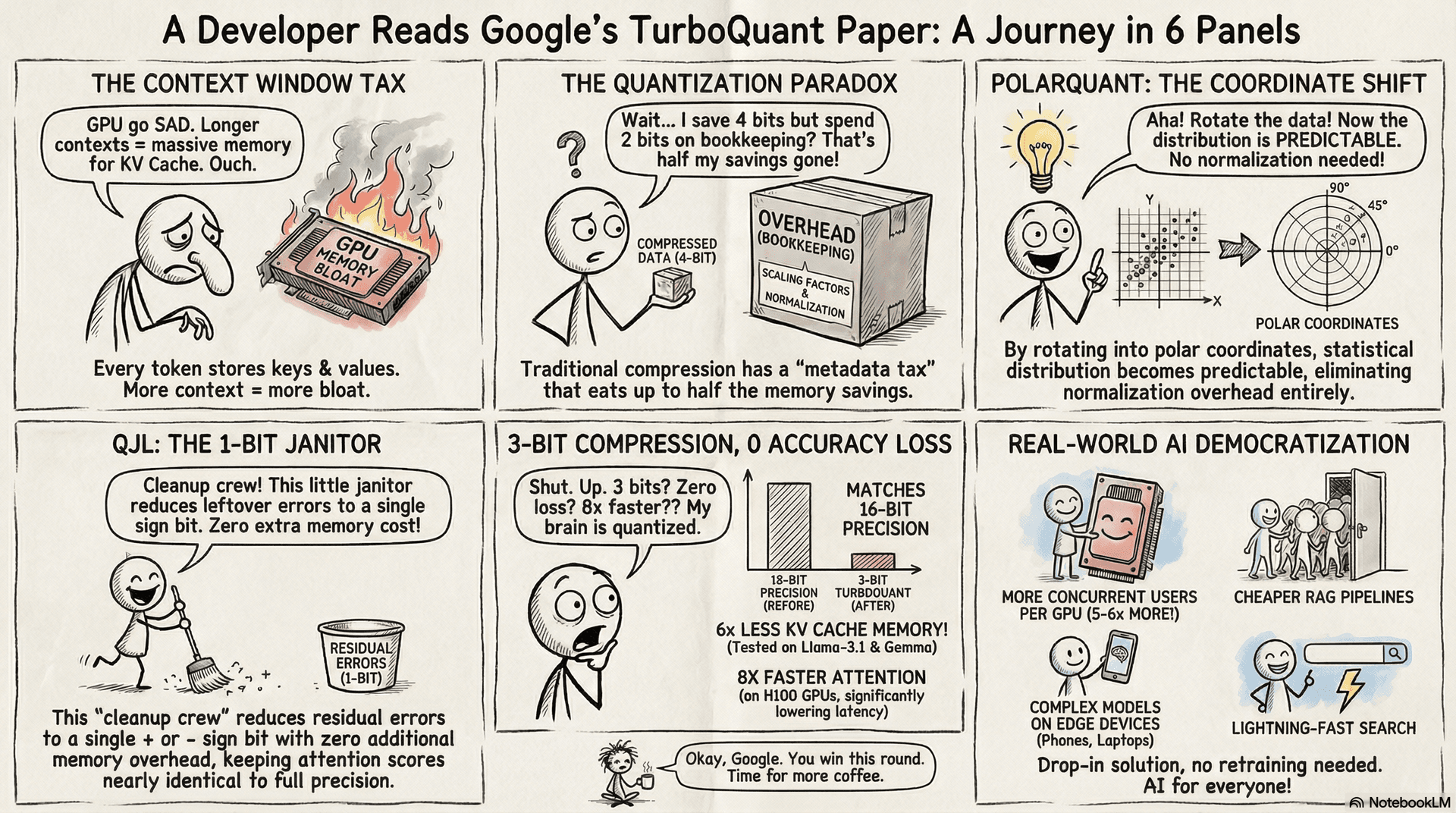
As context windows stretch to 128K, 256K, even 1M tokens, the key-value (KV) cache - the scratchpad an LLM fills with intermediate calculations so it doesn't reprocess everything from scratch - balloons into gigabytes of GPU memory per session. That's the actual cost driver. And until now, nobody had a clean solution.
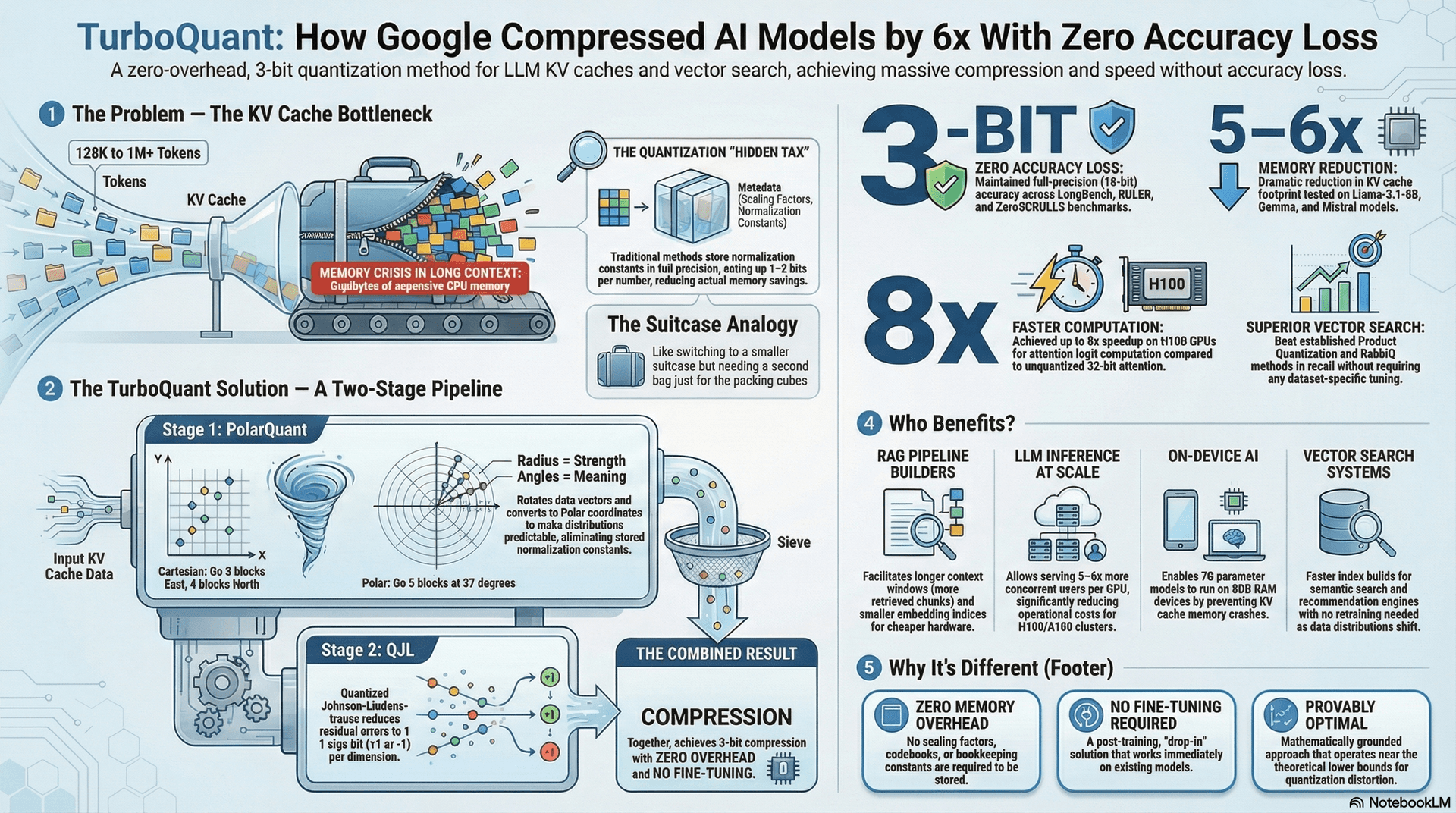
Traditional quantization methods try to compress this cache, but they carry a hidden tax: scaling factors, normalization constants, codebook entries, all stored in full precision. The overhead eats 1-2 bits per number back. It's like switching to a smaller suitcase but needing a second bag just for the packing cubes.
Google Research's TurboQuant (accepted at ICLR 2026) cracks this trade-off entirely. 3-bit compression. Zero accuracy loss. No fine-tuning. No overhead.
How TurboQuant works: the two-stage pipeline
TurboQuant pipelines two independent algorithmic contributions that happen to compose beautifully.
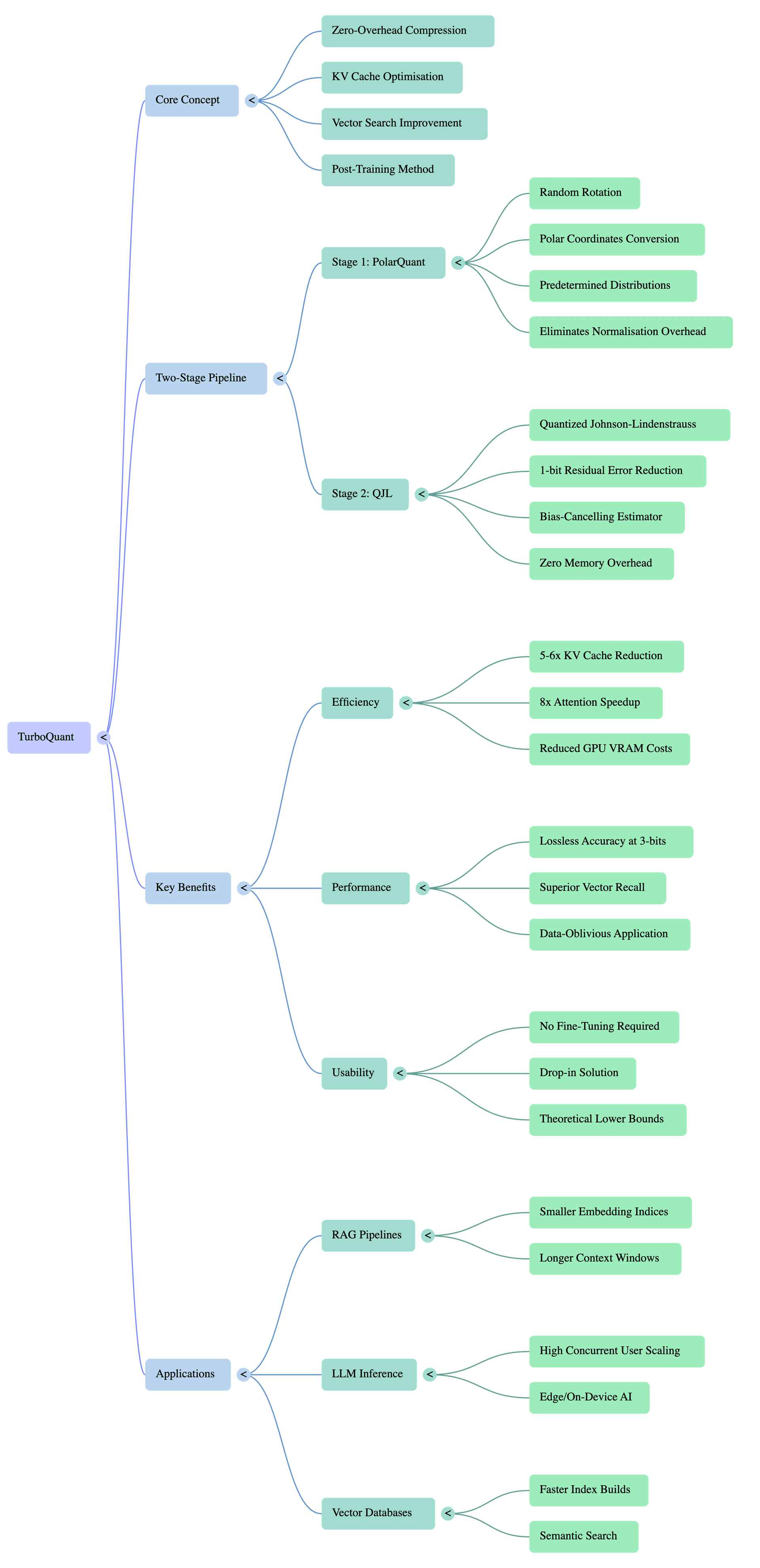
Stage 1: PolarQuant. Instead of compressing data in standard Cartesian coordinates, PolarQuant randomly rotates each data vector and converts it from Cartesian to polar coordinates. The radius captures the vector's overall strength. The angles capture its meaning. After rotation, the angle distributions become predictable and tightly concentrated, which means the expensive per-block normalization constants traditional methods store simply aren't needed anymore. The overhead disappears at the source.
Think of it this way: instead of giving someone directions as "Go 3 blocks East, 4 blocks North," you say "Go 5 blocks at 37 degrees." Same information. Simpler geometry. Zero bookkeeping.
Stage 2: QJL (Quantized Johnson-Lindenstrauss). PolarQuant is excellent, but it leaves a small residual rounding error. QJL takes that leftover and compresses it to a single sign bit (+1 or −1) per dimension, with zero additional memory overhead. It uses a special estimator that pairs high-precision queries against low-precision stored data so the biases cancel out mathematically. It's the 1-bit janitor that sweeps up what PolarQuant left behind.
Together: PolarQuant eliminating overhead at the compression stage, QJL eliminating residual bias with a free error check. The result is 3-bit KV cache compression with zero overhead and no fine-tuning required.
The numbers
These aren't "worked on our benchmark" results. They're tested across Llama-3.1-8B, Gemma, and Mistral, on five separate evaluation frameworks: LongBench, Needle in a Haystack, RULER, ZeroSCROLLS, and L-Eval.
- 3-bit KV cache compression with zero accuracy loss
- 5-6x reduction in KV cache memory footprint
- Up to 8x speedup on H100 GPUs for attention logit computation
- Superior recall vs. Product Quantization and RabbiQ on GloVe vector search benchmarks, achieved without any dataset-specific tuning
That last point deserves emphasis. TurboQuant is data-oblivious. You don't retrain. You don't tune codebooks. You don't rebuild indices when your data distributions shift. You apply it, and it works. That's rare in production.
Why this is different
Three things separate TurboQuant from the constant flood of quantization papers:
Zero memory overhead. No scaling factors, no codebooks, no normalization constants stored alongside compressed data. The savings are real savings.
No fine-tuning required. This is a post-training, drop-in method. It works on existing models immediately. You don't need a retraining budget or a labeled dataset.
Provably optimal. PolarQuant and QJL are backed by theoretical guarantees near information-theoretic lower bounds, not just empirical performance on a favorable test set. These are mathematically grounded results. That's not common in this field.
PolarQuant and QJL are also useful independently. You can apply either component to problems outside the KV cache context. The composability here is a feature, not an accident.
What this means if you build things
RAG pipeline builders: The most common RAG failure isn't retrieval; it's context window saturation. You retrieve 20 relevant chunks, but only 5 fit into generation context. A 5-6x KV cache compression shifts that ceiling dramatically. Smaller embedding indices, longer retrievable context in generation, better answers at lower cost.
LLM inference at scale: KV cache is the primary bottleneck for concurrent users on a shared GPU. Compress it by 5-6x and you serve 5-6x more users per H100, or cut your compute bill by the same factor. For anyone paying for cloud GPU time, this is a direct line to profitability.
On-device and edge AI: Models that currently need 16-24GB VRAM could realistically run on 4-8GB devices when the KV cache isn't eating memory. 7B parameter models on laptops and phones stop being hypothetical.
Vector search systems: Faster index builds, better recall than tuned baselines, zero retraining when data shifts. TurboQuant could become a default building block for semantic search infrastructure.
Because it requires no fine-tuning or retraining, TurboQuant drops directly into existing systems. No migration plan, no downtime window, no retraining run. That's the practical value that separates a research result from something you'd actually ship.
My take
This paper represents the quantization field maturing. Not another empirical trick that worked on someone's benchmark, but a theoretically grounded, composable set of building blocks with proofs attached.
PolarQuant and QJL are useful independently. They're not just parts of TurboQuant; they're algorithmic contributions that will show up in other contexts. Within a year, some version of these ideas will likely land in vLLM, TensorRT-LLM, or llama.cpp. The inference optimization space is moving fast, and the teams maintaining those engines read these papers.
The race in AI right now isn't just about bigger models. It's about making inference cheaper, faster, and more accessible - on more devices, at more price points. TurboQuant gives that goal a concrete address.
References
- TurboQuant paper, ICLR 2026
- QJL paper, AAAI 2025
- PolarQuant paper, AISTATS 2026
- Google Research blog